
REVIEW · POMPEII TOURS
Private Skip-the-line Pompeii & Mt. Vesuvius Tour from Sorrento
Pompeii and Vesuvius make a powerful one-day pairing: first, you walk through a Roman city frozen by ash, then climb the volcano that caused its destruction. The private vehicle and hotel pickup keep the day simple from Sorrento, while priority access saves time at both major sights.
I especially like the focused Pompeii guiding, which gives meaning to ordinary streets, bathhouses, shops, and homes. I also like that you reach the Vesuvius crater at 1,280 meters instead of merely viewing the mountain from below. The main caution is the price, $635.61 per person, and the Vesuvius walk can feel rushed or tiring if you need a slower pace.
Key points to know
- Pompeii in one concentrated visit: See the Forum, Temple of Jupiter, Macellum, Stabian Baths, House of the Faun, Lupanar, Large Theater, and Basilica.
- A real volcano walk: The vehicle drops you at about 1,000 meters, followed by an uneven path to the crater at 1,280 meters.
- Private from Sorrento: Your party rides together, with hotel pickup and return in a private vehicle.
- Strong Pompeii guides: Past tours have included Vincenzo Paduano, Paola, and Raffaella, with the Pompeii portion conducted in your selected language.
- Plan around the climb: The summit section allows about 30 minutes at the crater, so wear practical shoes and keep your pace steady.
- Bring food and water: Meals and drinks are not included, and the restroom at the base of the Vesuvius hike is very limited.
Why Pompeii and Vesuvius work so well together
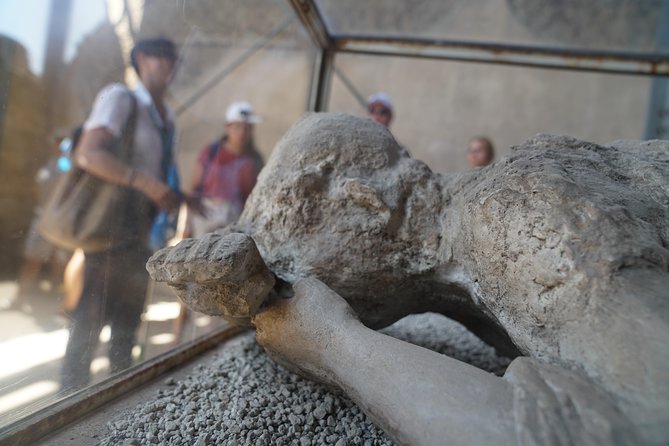
Many day trips from Sorrento force you to choose between Pompeii and Vesuvius. This tour gives you both, and the connection is more than geographical. At Pompeii, you see the streets, buildings, and daily routines of a Roman city. At Vesuvius, you look into the force that ended that city’s life in 79 A.D.
That change in scale is the day’s great strength. Pompeii feels human and detailed. Vesuvius feels broad, exposed, and unsettling. You move from painted walls and household mosaics to a crater rim with views across the Gulf of Naples.
The tour lasts about eight hours, including transport from Sorrento. Since it is private, you do not need to fit your day around a large group. You can ask questions, hear explanations suited to your interests, and keep your own party together.
This is not the cheapest way to visit Pompeii. At $635.61 per person, the value depends heavily on your group size and on how much you value private transport, guided sightseeing, and saved time. For a family or small group splitting the cost, it can make more sense than arranging separate transfers and entry tickets. For one or two people on a tight budget, the price deserves careful thought.
More ways up Mount Vesuvius:
- Priority Access Pompeii & Mt. Vesuvius Full day from Sorrento
★ 4.5 · 1,376 reviews - From Sorrento: Pompeii and Vesuvius Guided Tour with Lunch
★ 4.8 · 683 reviews - From Sorrento: Day Tour to Pompeii Ruins and Mount Vesuvius
★ 4.3 · 489 reviews
Leaving Sorrento in a private vehicle
Your day begins with pickup from your Sorrento-area hotel, or at the stated meeting point at Piazza Torquato Tasso, 16. The private vehicle is a practical advantage because public transport between Sorrento, Pompeii, and Vesuvius would add planning and waiting time.
Your driver speaks English or Italian. The driver is not necessarily your Pompeii guide. A separate guide leads the archaeological visit, while the driver handles the road travel and return to Sorrento.
This division can work very well. A strong driver can give you local background on the way, then hand over to a specialist at Pompeii. Past departures have included drivers such as Fabio and Pompeii guides including Vincenzo Paduano, Paola, and Raffaella. Names are not guaranteed for your date, but the guide is assigned according to availability.
Confirm your pickup time and location at least 48 hours before departure. That small step matters in the Sorrento area, where hotel addresses, pedestrian lanes, and meeting spots can cause confusion.
Entering Pompeii through the archaeological park
You have roughly two hours at Pompeii, with priority access included. That is enough for a purposeful introduction, but not enough to inspect every street and house in this huge site.
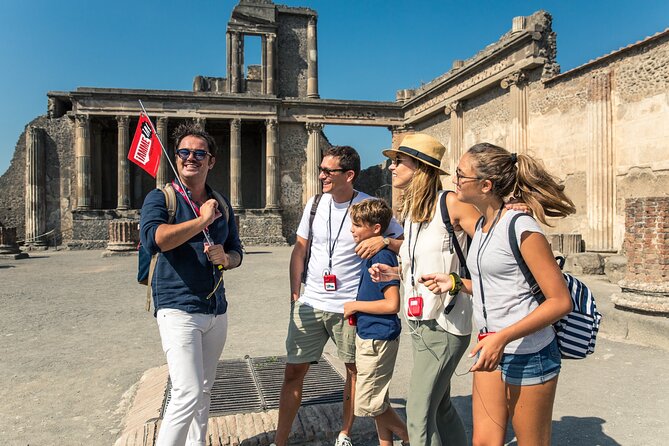
The best use of the time is to stay with your guide and focus on the city’s main public buildings and a few memorable private spaces. Pompeii can otherwise become a blur of broken walls and Latin names. Good explanations help you picture the city as a working place rather than a pile of ruins.
The tour takes in several of Pompeii’s key areas:
The Civil Forum and Temple of Jupiter
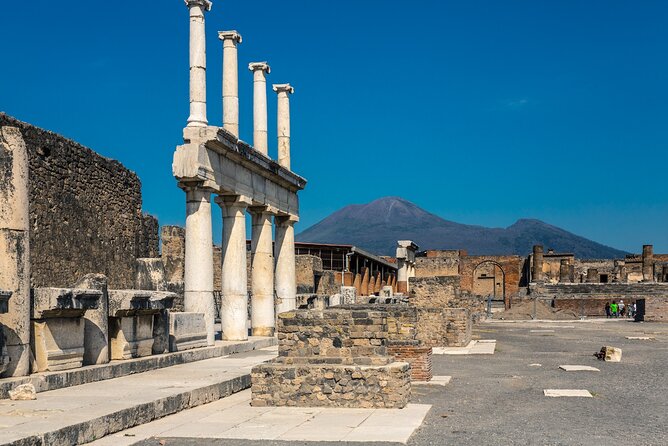
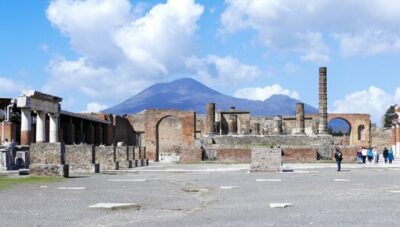
The Civil Forum was the city’s central public square. Government, justice, trade, markets, and worship all met here, making it the right place to begin understanding Pompeii’s civic life.
At the north end, the Temple of Jupiter frames the Forum. Mount Vesuvius rises behind it, creating one of the clearest visual links between the ancient city and the volcano. The temple was remodeled after Pompeii became a Roman colony in 80 B.C., with Jupiter, Juno, and Minerva honored in the Capitolium tradition.
You have only about ten minutes listed for this stop, so your guide’s explanation matters. Take a moment to look past the stones and notice the original planning of the square.
More Pompeii tours from Sorrento:
- Sorrento: Skip-the-Line Pompeii Express Tour by Train
★ 4.8 · 2,038 reviews - Pompeii Express Guided Tour by Train from Sorrento
★ 4.5 · 770 reviews - Skip-the-Line Pompeii Guided Tour from Sorrento
★ 4.5 · 722 reviews - Pompeii Ruins Half-Day Tour from Sorrento with Guide
★ 4.0 · 714 reviews
The Macellum and Via dell’Abbondanza
The Macellum was a market building with rooms linked to food sales and religious activity. Its layout hints at the close relationship between commerce, public ceremony, and imperial worship in Roman life.
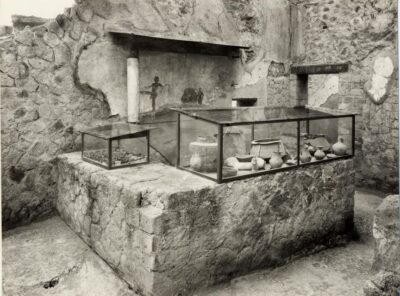
Via dell’Abbondanza was Pompeii’s main east-west street. It once carried people past shops, workshops, snack bars, cafes, and restaurants. Today, the worn paving stones and surviving storefronts help you imagine a noisy commercial street rather than a silent ruin.
The short stops here are useful for seeing how ordinary business fit into the city. If you enjoy daily-life details more than grand monuments, pay close attention to this section.
The Stabian Baths
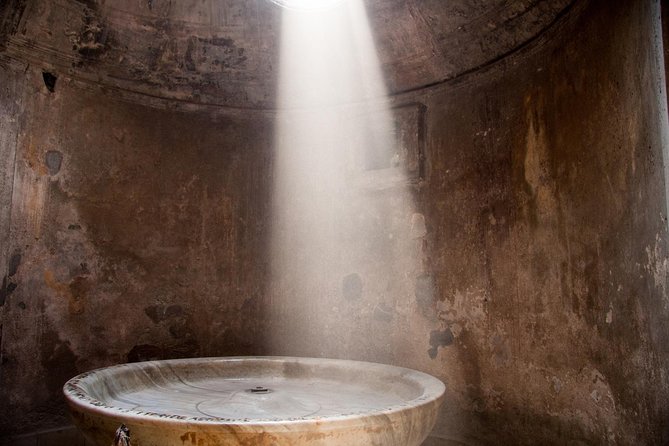
The Stabian Baths show how Romans built public bathing into city life. The complex included separate men’s and women’s areas, along with rooms for changing, cold baths, warm rooms, and hot baths.
The baths were badly damaged in the earthquake of 62 A.D., seventeen years before the eruption. That detail adds an important layer to Pompeii: the city was already being repaired and reshaped when Vesuvius finally erupted.
The stop is brief, but the sequence of rooms makes the Roman bathing system easier to understand. You will get more from it if you listen for how heat and water moved through the building.
The House of the Faun
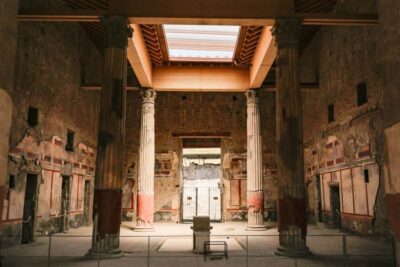
The House of the Faun occupied an entire city block and was one of Pompeii’s grandest private homes. It takes its name from a bronze dancing faun found in the main atrium.
The house is especially famous for the Alexander Mosaic, which shows Alexander the Great fighting Darius III of Persia. Its two gardens, mosaics, and large scale offer a sharp contrast to the smaller homes and shops along Pompeii’s streets.
The house was linked to the Poppei family, relatives of Poppea Sabina, Nero’s second wife. You may not have time to study every room, but this stop gives you a clear sense of how the city’s wealthiest families lived.
The Lupanar
The Lupanar was a brothel, identified by its small rooms and erotic wall paintings. The name comes from the Latin word for brothel, and the building is among Pompeii’s most talked-about stops.
It is also a useful reminder that Pompeii was not preserved as a polished Roman showpiece. The city included trade, religion, entertainment, domestic life, and paid sex, all packed into the same urban fabric.
The rooms are small, and this can be one of the more crowded parts of a Pompeii visit. Follow your guide’s explanation, then move on rather than expecting a long stop.
The Large Theater and Basilica
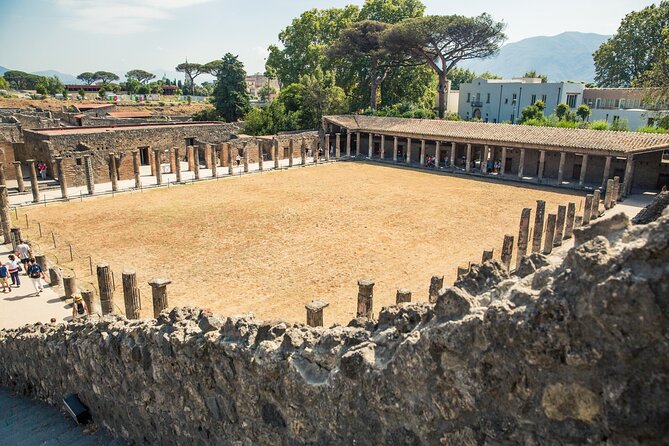
The Large Theater used the natural slope of the site to form an auditorium divided into five sections. Performances included tragedies from Greek and Roman traditions.
The theater helps restore a sense of public entertainment, while the Basilica shows Pompeii’s business and legal side. With about 1,500 square meters, the Basilica was the Forum’s most impressive building and served commercial and judicial purposes.
Together, these stops show how much of Roman life happened in public. Pompeii was not only a town of villas and temples. It was also a place for court cases, commerce, theater, bathing, worship, and quick meals.
Climbing Mount Vesuvius to 1,280 meters
After Pompeii, the private vehicle continues to Vesuvius National Park. You are dropped at about 1,000 meters and then walk toward the crater edge at 1,280 meters.
The path is uneven. This is a genuine uphill walk, not a scenic viewpoint reached directly from the parking area. The tour provides priority access and the Vesuvius entrance ticket, but you still need to supply the physical effort.
The listed timing allows about one hour at the volcano, including roughly 30 minutes at the crater. A fit person can make the climb and return within that window, but your pace matters. One previous departure found the timing tight and turned back after reaching just short of the caldera. Another spent about an hour and a half at Vesuvius and reached the Gran Cono, so the practical pace can vary.
I would ask your driver at the start of the day to confirm exactly where and when to meet after the walk. Keep track of the return time yourself. The climb is more enjoyable when you can look around without wondering if you will miss the vehicle.
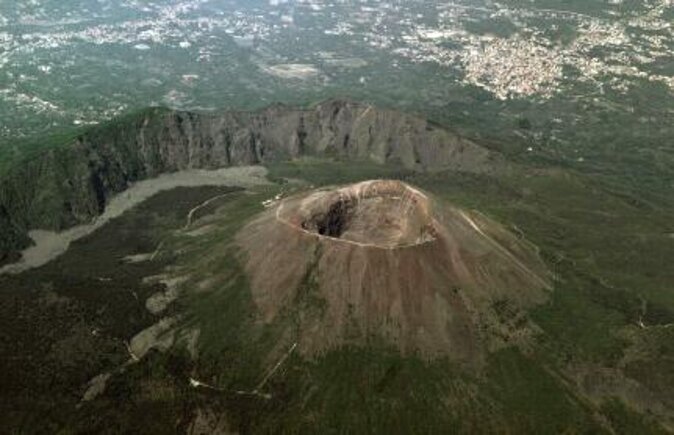
At the top, the crater is the main event. You can see the volcano’s raw interior and take in the Gulf of Naples from high above. Mount Somma, the older attached mountain, forms part of the volcano’s distinctive profile.
Vesuvius destroyed Pompeii and Herculaneum in 79 A.D. It is still monitored around the clock because of the large magma system beneath it. That fact gives the visit a serious edge. You are not simply looking at an extinct cone. You are standing beside an active and closely watched volcano.
The restroom at the base of the hike is described as very poor, so use facilities before arriving if possible. Bring water, and do not count on buying lunch or drinks as part of the tour. Food and beverages are not included.
What the private format adds
The private format is most valuable in the transitions. You are not waiting for a large group to board a bus, and hotel pickup removes the need to reach a transport hub early in the morning.
At Pompeii, the private guide can adjust the explanation to your interests. You might spend more time on the House of the Faun if mosaics appeal to you, or ask more about baths, shops, and public life. A large group generally gives you less room for that kind of exchange.
The vehicle also gives you a place to rest between the archaeological site and the volcano. That matters because the two activities use your energy in different ways: Pompeii involves steady walking over ancient paving and Vesuvius involves a sustained uphill climb.
The tradeoff is cost. You are paying for privacy, transport, entry, and a guided Pompeii visit, not just for admission to two attractions. If you already have transport and only want a short look at Pompeii, this package may be more than you need.
How demanding is the day?
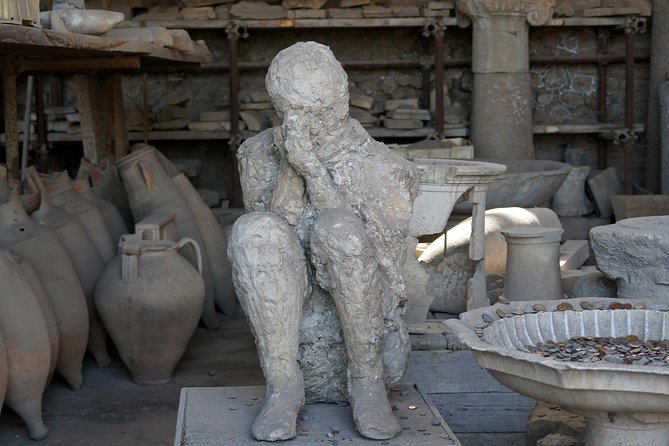
Most travelers can take part, but the day is not physically effortless. Pompeii involves a lot of walking over uneven ancient surfaces, and the volcano adds a steeper route.
A 70-year-old couple completed the day but found the Vesuvius walk challenging. That does not mean the climb is unsuitable for older visitors. It means you should judge it by your own walking speed and comfort on uneven ground.
Wear sturdy shoes and keep your expectations realistic. You are not required to race to the crater, but the schedule has limited time. If someone in your group needs frequent breaks, the Pompeii portion may need to be shorter so the volcano walk remains manageable.
The day also includes little downtime. You may want to eat before pickup or carry suitable snacks, since food and drinks are excluded. The schedule is efficient, but efficiency can feel demanding in warm weather.
Is $635.61 per person a fair price?
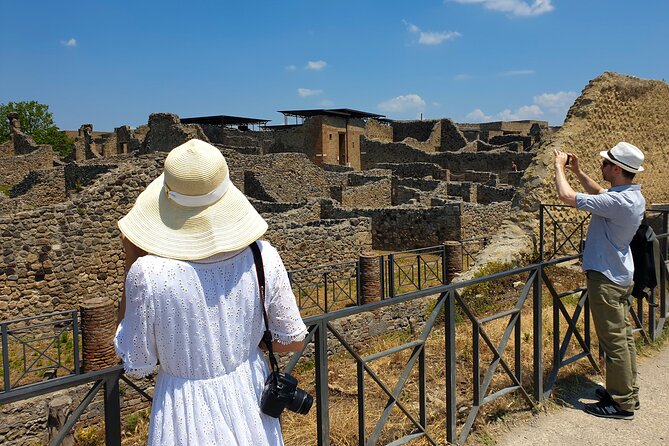
The price is high, so the right question is what you would otherwise need to arrange. This tour includes private transportation, an English-speaking driver, a private Pompeii guide, priority access to Pompeii, priority access to Vesuvius, and the Vesuvius entry ticket.
Pompeii admission is included as part of the visit, and the day returns you to Sorrento. That saves you from coordinating separate train, bus, taxi, and guide arrangements.
For a family or group that wants a private vehicle, the price may be reasonable when divided among several people. Group discounts are offered, though the exact saving is not specified. For a couple, the cost is harder to justify unless you place a high value on comfort and a private guide.
The experience has a strong overall rating of 4.9 from 15 ratings, with 93 percent recommending it. The praise centers on the Pompeii guides and the professionalism of some drivers. The main warning is that driver quality and time management can affect how relaxed the Vesuvius portion feels.
Who should book this Sorrento day trip?
I would recommend it to you if you want both major sights in one day and prefer not to manage local transport. It is especially suited to families, first-time visitors to the Bay of Naples, and small groups that can share the private-tour cost.
It is also a good fit if you want historical context rather than a quick photo stop. Guides such as Vincenzo Paduano have been singled out for bringing Pompeii’s buildings and daily life into focus, while Paola and Raffaella have also led the archaeological visit.
I would hesitate if you want a slow, unhurried Pompeii visit. Two hours gives you a useful route through the main sights, but Pompeii can easily fill an entire day for anyone interested in frescoes, houses, inscriptions, and side streets.
I would also think twice if your group dislikes uphill walks, has limited mobility, or wants a long lunch. The volcano section is active, exposed, and time-limited.
Final booking advice
Book this tour if your priority is door-to-door convenience and a guided first look at Pompeii plus the crater of Vesuvius. The pairing is memorable, and the private vehicle makes a complicated day much easier.
Before paying, confirm the pickup details, ask how the Vesuvius meeting time will work, and make sure everyone in your group is comfortable with the uneven uphill path. Cancel at least 24 hours before the start time for a full refund. With those details settled, this is a strong choice for a focused, high-value day from Sorrento, but not for a low-cost or leisurely outing.
FAQ
How long does the tour last?
The experience lasts approximately eight hours, including pickup and return to Sorrento.
Where does the tour start?
Pickup is offered from hotels in the Sorrento area. The listed meeting point is Piazza Torquato Tasso, 16, 80067 Sorrento.
Does the tour return to Sorrento?
Yes. The private vehicle returns you to your hotel in Sorrento or to the meeting point.
Is the tour private?
Yes. Only your group participates in the private activity.
Is Pompeii admission included?
Yes. Priority access to Pompeii Archaeological Site and the Pompeii visit are included.
Is the Mount Vesuvius ticket included?
Yes. The Mount Vesuvius entrance ticket and priority access are included.
What language is the tour offered in?
The Pompeii tour operates in the language selected when booking. The driver speaks English or Italian.
Is a guide included at Pompeii?
Yes. A private guide leads the Pompeii tour.
Is food included?
No. Food and drinks are not included, so plan to eat before the tour or bring suitable refreshments.
Is the Vesuvius walk difficult?
The route has an uneven surface and climbs from about 1,000 meters to the crater edge at 1,280 meters. The climb can be challenging, especially if you need a slower pace.
Can I cancel for a refund?
You can cancel at least 24 hours before the local start time for a full refund. Cancellations or changes made less than 24 hours before departure are not refunded.
More skip-the-line entries near Sorrento
- From Sorrento: Pompeii Half-Day Skip-the-Line Tour
★ 4.6 · 541 reviews - From Naples: Pompeii Skip-the-Line Guided Tour
★ 4.5 · 154 reviews - Sorrento: Pompeii & Herculaneum Tour with Skip-the-Line
★ 4.6 · 125 reviews - Herculaneum: 2-Hour Skip-the-Line Tour from Sorrento
★ 4.0 · 46 reviews
New on the Sorrento list
- Vico Equense: Authentic Cooking Class at a Local’s Home★ 5.0 · 4 reviews
- Vico Equense: Dining Experience at a Local’s Home★ 5.0 · 4 reviews
- Vico Equense: Tour in the dairy “Mozzarella Experience”★ 5.0 · 19 reviews
- Private tour of Amalfi Coast★ 5.0 · 71 reviews
- Private Virtual Cooking Class from Sorrento★ 5.0 · 25 reviews
- Sorrentomaxiboat tours to Capri★ 5.0 · 63 reviews
- Private transfer from Salerno to the Amalfi Coast, or vice versa★ 5.0 · 30 reviews
- Yoga Experience – Sorrento★ 5.0 · 29 reviews
Pompeii Tours, compared.
Priority Access Pompeii & Mt. Vesuvius Full day from Sorrento
Read our review →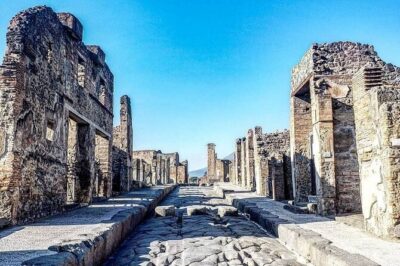
Pompeii Express Guided Tour by Train from Sorrento
Read our review →
Skip-the-Line Pompeii Guided Tour from Sorrento
Read our review →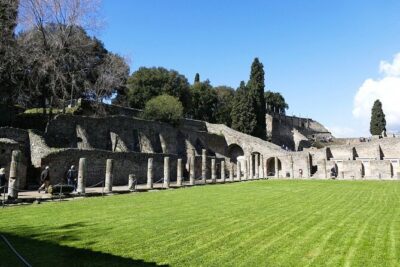
Pompeii Ruins Half-Day Tour from Sorrento with Guide
Read our review →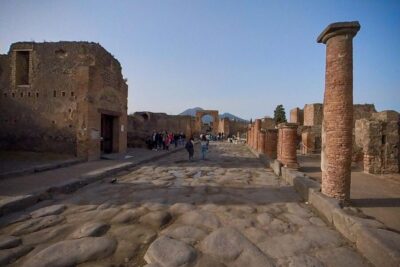
Browse the lists this tour appears in