
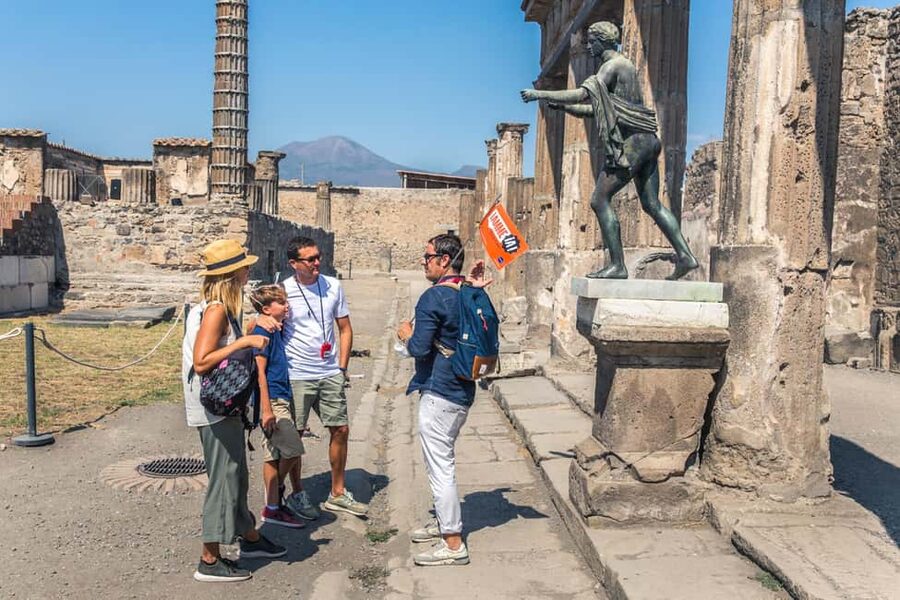
REVIEW · POMPEII TOURS
From Naples: Pompeii Skip-the-Line Guided Tour
Pompeii is not just a pile of old stones. It is a Roman city you can walk through, with chariot grooves in the streets, ovens in bakeries, painted rooms, and public baths that still show how people lived. This four-hour trip from Naples gets you there by air-conditioned bus and gives you a guide to explain what you are seeing.
I like two things here: the early departure, which can make the site cooler and less crowded, and the focused route through Pompeii’s best-known buildings. You also get priority entry and a return ride, useful when Naples traffic and regional trains feel like more work than your holiday deserves.
The tradeoff is time. Two and a half hours inside Pompeii is enough for major highlights, but not enough to explore this huge archaeological site at your own pace. The walking can be hard in hot sun, and this tour is not suitable for people with mobility impairments or heart problems.
Key points to know before booking
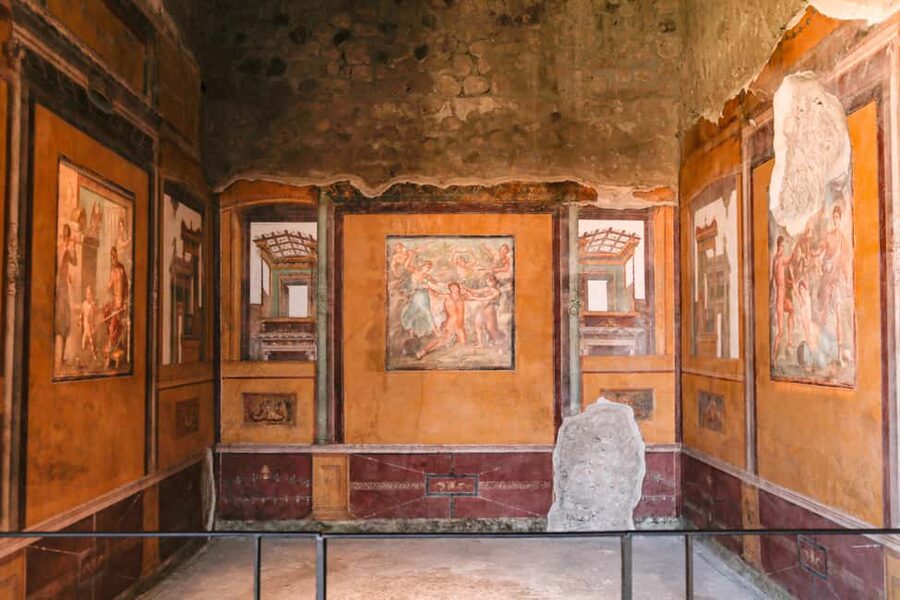
- Begin at Porta Marina: Enter Pompeii through one of its original gates before following the route toward the Forum.
- See the city’s main sights: The tour covers the Civil Forum, Temple of Jupiter, Basilica, Macellum, baths, Lupanare, House of the Faun, and Large Theater.
- Expect a brisk walking tour: The guided visit lasts 2½ hours, with little room for long personal stops.
- Priority entry saves hassle: You use a separate entrance rather than joining the standard line.
- Headsets help larger groups: Groups of eight or more receive audio equipment, though signal can sometimes weaken in crowds.
- Plan for heat and uneven ground: Wear comfortable shoes, bring water, and carry sunglasses and a sun hat.
From Naples to Pompeii in 30 minutes
The meeting point is outside Starhotels Terminus at Piazza Giuseppe Garibaldi 91, beside Naples Central Station. This is convenient if you are staying near the station or arriving by train, but it is not a hotel pickup for everyone. One past participant found the walk from a hotel awkward, so check your route before the morning of the tour.
The ride to Pompeii takes about 30 minutes by comfortable, air-conditioned bus or minibus. That short transfer is one of the tour’s practical strengths. You avoid figuring out which train to take, where to enter the site, and how to coordinate your return to Naples.
The pickup process can be busy when several departures gather at once. Arrive early, keep your booking details ready, and look for the coordinator outside the hotel entrance. Some earlier trips arrived ahead of schedule, so do not cut it close.
The tour can run in English, French, Spanish, or German. If too few people choose French or Spanish, the main tour may be in English, with some French or Spanish commentary during the Pompeii visit. Private and small-group options are available, but the exact group size depends on the option you select.
More days out that start in Naples:
- Capri and Blue Grotto Day Tour from Naples or Sorrento
★ 4.5 · 1,000 reviews - Small Group Tour of Capri & Blue Grotto from Naples and Sorrento
★ 5.0 · 186 reviews - PRIVATE DAY TOUR OF AMALFI COAST from Naples/Salerno/Sorrento or Positano
★ 5.0 · 62 reviews
Entering through Porta Marina
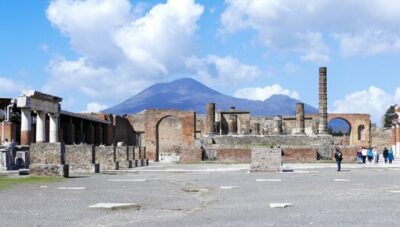
Pompeii covers a large area, so a guide helps you get your bearings quickly. The visit begins at Porta Marina, one of the ancient city gates. From there, the route moves toward the Civil Forum, the city’s central public square.
This is where Pompeii starts to make sense. Temples, government buildings, shops, and gathering spaces once surrounded the Forum. Mount Vesuvius rises nearby, giving the ruins their dramatic setting and reminding you that the city’s destruction was not a slow decline. It was a sudden interruption of ordinary life.
The Forum is a good place to pay attention to scale. Pompeii was not a small village frozen in time. It was a functioning Roman city with public institutions, commerce, religion, entertainment, and private homes packed along paved streets.
The Forum, Temple of Jupiter, and Basilica
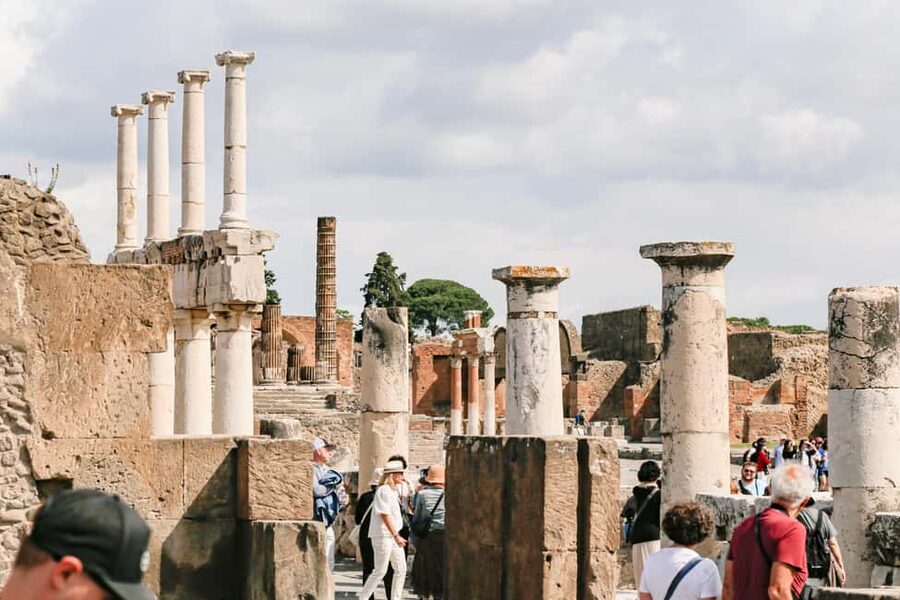
The Temple of Jupiter is one of the key stops around the Forum. Your guide explains its place in Roman religious life and points out the remains that are easy to miss when you walk through alone.
Nearby, the Basilica gives you a look at the city’s legal and commercial side. This was not a church in the later Christian sense. It was used for business dealings and court matters, so it helps show how public life worked in Pompeii.
I like this part of the route because it connects ruins to purpose. Without explanation, a row of columns can look impressive but vague. With context, you can picture people handling contracts, settling disputes, worshipping, shopping, and meeting friends in the same compact district.
Walking Via dell’Abbondanza
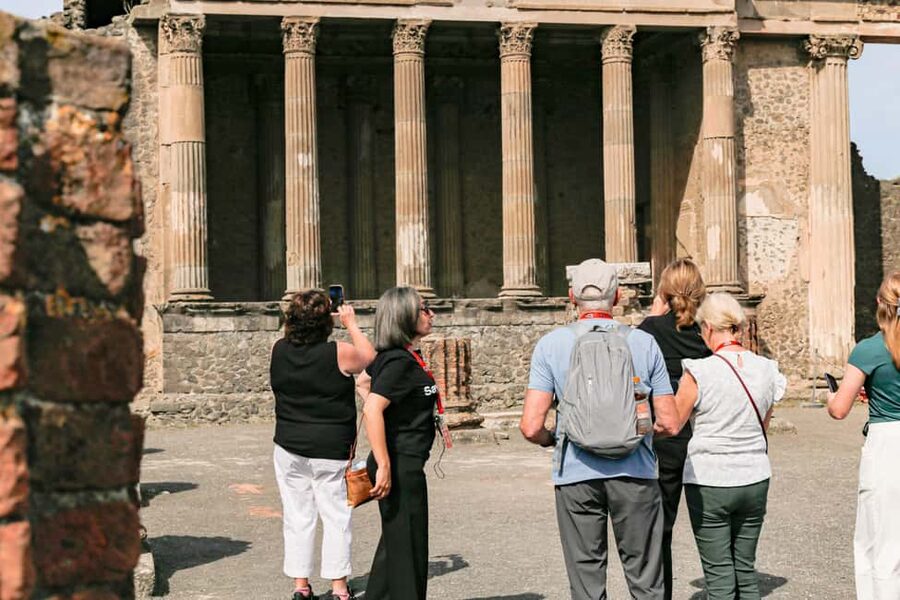
Via dell’Abbondanza was one of Pompeii’s main streets. You walk along a route lined with homes, shops, and signs of daily movement, including the grooves cut by ancient cart wheels.
The street itself is one of the most revealing parts of the visit. The grand villas get the attention, but the road shows how ordinary residents moved through the city. Look down as you walk. The stone surfaces, raised crossings, and wheel marks tell you more about practical Roman life than a formal monument can.
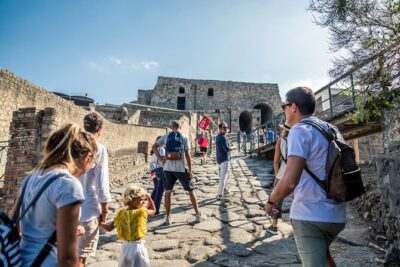
This is also where the walking conditions become clear. Pompeii has uneven paving and limited shade. A guide generally keeps the group moving at a steady pace, which helps you see the main sights but means you may not have time to linger at every doorway or inscription.
More Pompeii tours from Sorrento:
- Sorrento: Skip-the-Line Pompeii Express Tour by Train
★ 4.8 · 2,038 reviews - Priority Access Pompeii & Mt. Vesuvius Full day from Sorrento
★ 4.5 · 1,376 reviews - Pompeii Express Guided Tour by Train from Sorrento
★ 4.5 · 770 reviews - Skip-the-Line Pompeii Guided Tour from Sorrento
★ 4.5 · 722 reviews
Theaters, baths, and the city’s leisure life
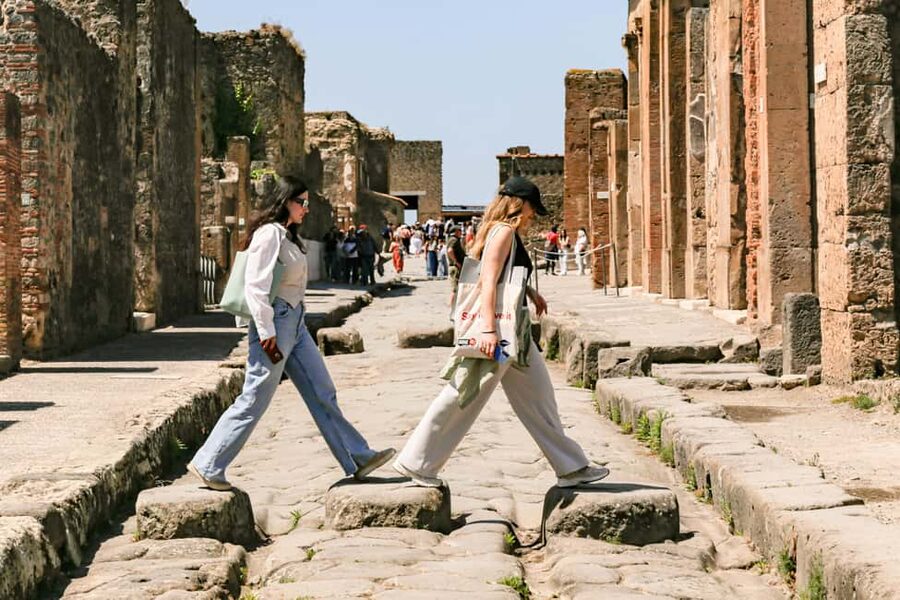
The Theater District shows another side of Pompeii. The Large Theater hosted comedies, dramas, and musical performances in an open-air setting. Your guide can help you picture the audience, the stage, and the social role of entertainment in Roman life.
The nearby bath complex offers a smaller, more intimate look at daily routines. The Terme Stabiane, or Stabian Baths, reveal how public bathing mixed washing, relaxation, and social contact. Preserved rooms and architectural details make this stop especially useful for understanding that Roman public buildings were designed for more than one function.
The theater and baths also break up the heavy focus on the eruption. You are not only seeing a disaster site. You are seeing a city where people worked, exercised, watched performances, met friends, and followed familiar routines.
The Lupanare, thermopolium, and bakery
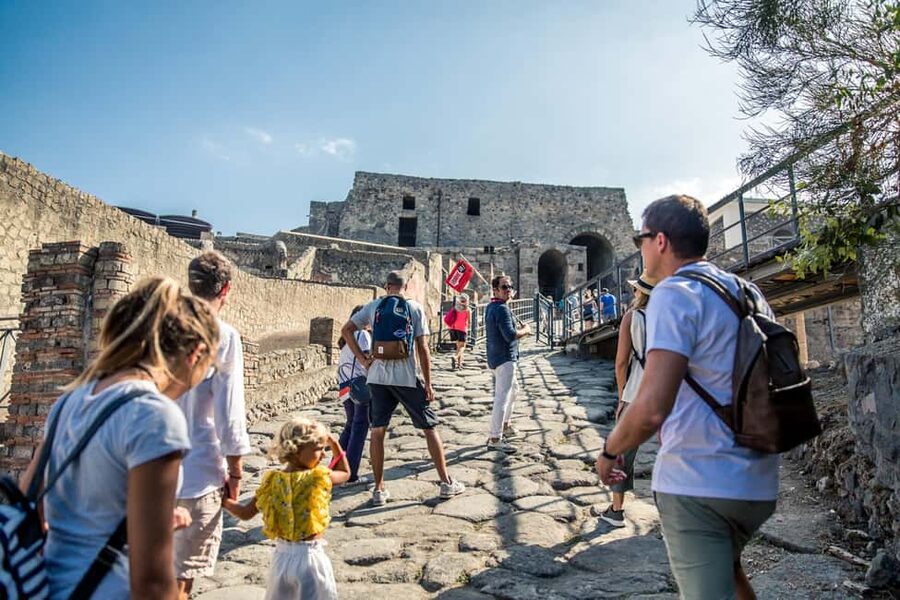
The Lupanare is Pompeii’s ancient brothel. Its small rooms and surviving frescoes make it one of the most talked-about stops, but it is best understood as part of the city’s wider commercial life rather than treated as a novelty.
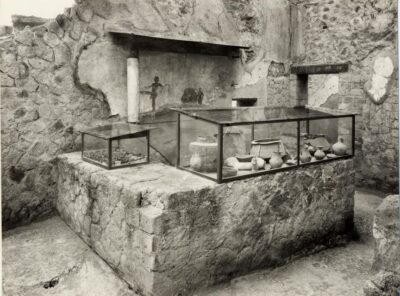
You may also see a thermopolium, an ancient street food shop. Counters and serving areas show how residents could buy prepared food instead of cooking every meal at home. A pistrinum, or bakery, adds another useful detail, with millstones, ovens, and work areas that show how bread was produced.
These stops are valuable because they bring the city down to street level. The Forum shows official power. The bakery and food counter show what people ate and how local businesses served them. That contrast makes Pompeii feel less like a museum and more like a place where people had errands to run.
House of the Faun and the Alexander Mosaic
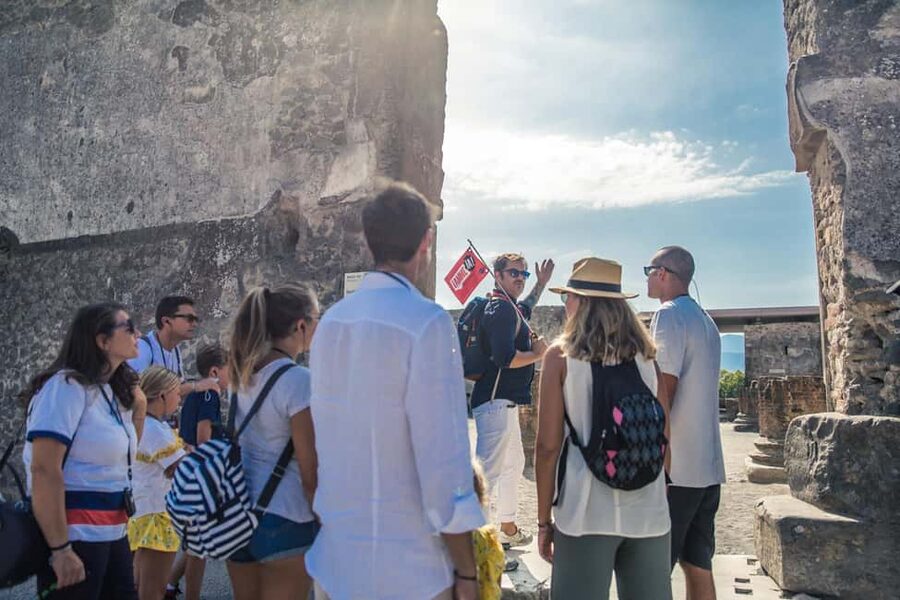
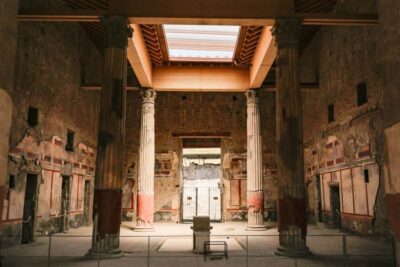
The House of the Faun is one of Pompeii’s grandest private residences. Its size and decoration show the lifestyle of the Roman elite, with large rooms, courtyards, and important mosaics.
The famous Alexander Mosaic is the artistic highlight. It depicts Alexander the Great facing the Persian king Darius and is valued for its movement, detail, and storytelling. Even if you are not an art specialist, the mosaic gives you a clear sense of the money and taste behind a wealthy Pompeian home.
This is a stop where you may wish for more time. The guided schedule keeps the group on course, but a major house can reward slow looking. If the group pauses only briefly, remember the location and return independently only if your schedule and ticket arrangements allow it. The tour itself does not promise free time for a second visit.
Macellum and the plaster casts
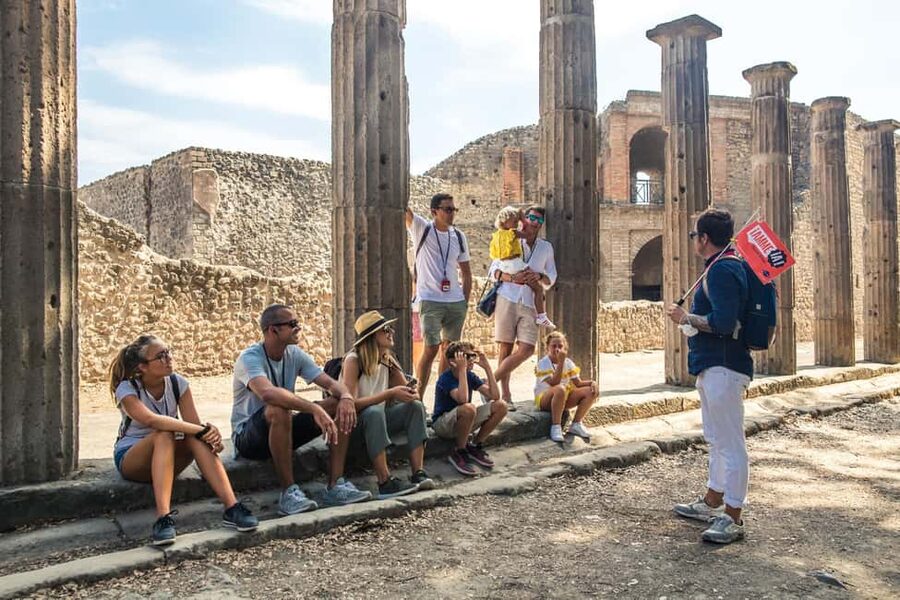
The Macellum was Pompeii’s food market, a place where daily trade brought people together. This stop completes the picture built by the Forum, shops, bakery, and private homes.
The most emotional moment comes when you see plaster casts of people who died in the eruption. These casts include men, women, and children. They are not simply archaeological objects. They make the disaster personal and show that the city was full of families and individuals when life stopped.
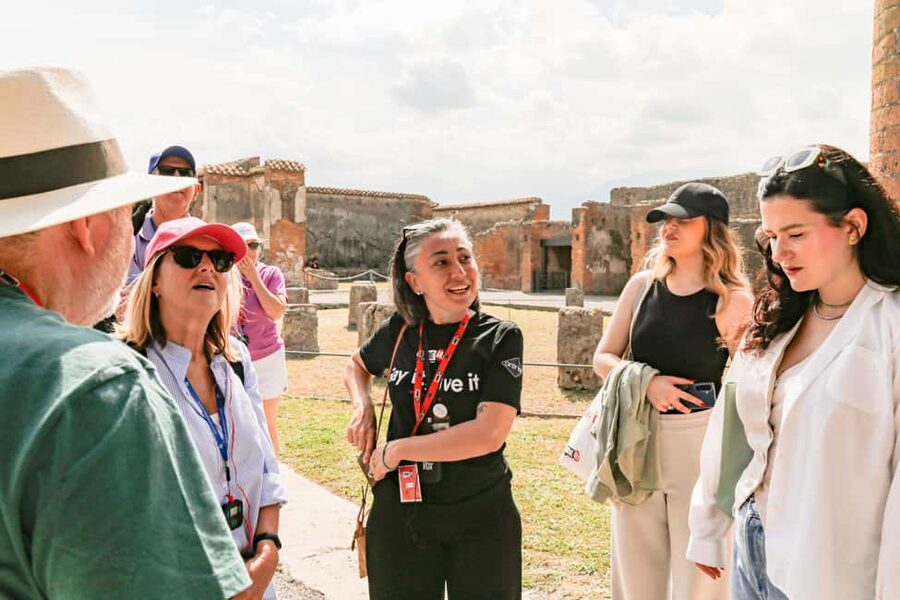
Your guide’s handling of this section matters. Strong guides such as Lucia, Luigi, Sasa, and Francesco have been praised for making the ancient city understandable through stories, humor, and clear explanations. Guides do not all have the same style. One may be warm and lighthearted, while another may sound more like a strict professor. The quality of the visit depends in part on that match.
What the guided format adds
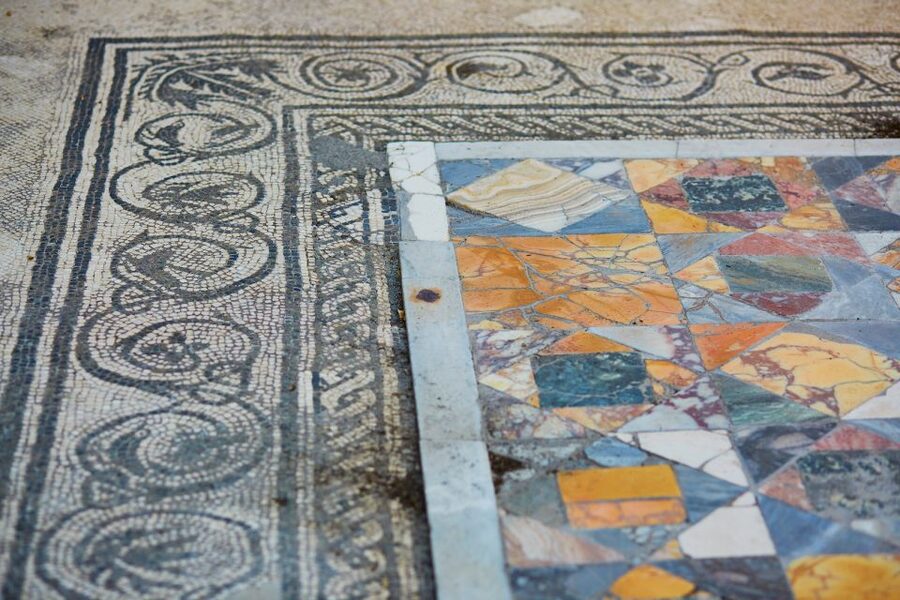
I would choose a guide at Pompeii unless you have already studied the site closely. The ruins are extensive, and it is easy to spend time looking at walls without understanding what each building did.
The best part of the guided format is the connection between places. The Temple of Jupiter explains public religion. The Basilica explains law and business. Via dell’Abbondanza shows movement and commerce. The thermopolium and bakery reveal food culture. The House of the Faun shows private wealth. The casts return the story to human loss.
Groups of eight or more receive audio headsets. These let you hear the guide while walking through a crowd, but they are not flawless. A headset can lose signal when people spread out or other groups block the connection. Stay reasonably close, and tell the guide if you cannot hear.
The route can also be conducted in more than one language. This is useful for mixed groups, but multilingual explanations may make the pace feel less even. If a particular language is essential, confirm the selected option before paying.
Is $71 a fair price?
At $71 per person, the tour costs more than arranging a basic train ride and site admission yourself. You are paying for priority access, round-trip transport, and a licensed local guide, not just a Pompeii ticket.
For many people, that is fair value. The bus removes transport planning, the separate entrance reduces line worries, and the guide gives structure to a very large site. The value is strongest if you have one morning, are visiting Pompeii for the first time, or do not want to manage Naples and Pompeii connections on your own.
The price is less attractive if you prefer to explore slowly, stop for photographs whenever you like, or spend half a day in one villa. Two and a half hours is a sensible introduction, but it is a highlights tour. You will not see every street, house, or exhibition.
Food and drinks are not included. Bring a water bottle. Pompeii has fountains where you can refill, and public toilets may require a small fee, so carrying 50 euro cents is a sensible tip from past experience. There is no need to build a meal into this short morning plan, and many people are back in Naples in time for lunch.
Heat, walking, and practical comfort
Wear sturdy, comfortable shoes. Pompeii’s ancient paving is uneven, and the route covers a lot of ground. Take sunglasses and a sun hat, especially from late spring through early autumn.
Shade is limited, and the site can feel demanding in hot weather. One advantage of the early start is that you may avoid the worst afternoon heat and some of the heaviest crowds. Still, do not treat this as an easy stroll.
The experience is not suitable for people with mobility impairments or heart problems. If you tire easily, ask about the private or small-group option before booking, but do not assume it changes the site’s uneven surfaces or walking demands.
Free cancellation is available up to 24 hours before departure, and you can reserve now and pay later. These policies help if your Naples schedule is still shifting, but the central decision is simpler: decide if a brisk, guided introduction suits you better than a longer independent visit.
Who should book this Pompeii tour?
Book it if you want to see Pompeii from Naples without arranging transport, prefer a clear route through the major sights, and value a local guide’s explanation. It is particularly useful for first-time visitors, short stays, and anyone who wants to return to Naples for lunch.
Think twice if you want to examine inscriptions, sketch buildings, or wander without a fixed pace. Pompeii rewards time, and this tour gives you a strong overview rather than complete freedom.
For most first visits, I think the combination of early departure, priority entry, air-conditioned transport, and a licensed guide makes the $71 reasonable. Just arrive early at Starhotels Terminus, bring water and sun protection, and expect a serious morning of walking.
FAQ
Where does the tour meet in Naples?
Your guide waits outside the main entrance of Starhotels Terminus at Piazza Giuseppe Garibaldi 91.
How long does the tour last?
The full activity lasts four hours, including approximately 30 minutes of travel each way and a 2½-hour guided visit inside Pompeii.
Is transportation included?
Yes. Round-trip transportation in a comfortable air-conditioned bus or coach is included.
Does the tour include priority entry to Pompeii?
Yes. You enter through a separate entrance with priority access.
Which languages are available?
Tours may be offered in English, French, Spanish, or German. If too few French or Spanish speakers join, the main tour may be in English, with French or Spanish commentary during the Pompeii visit.
Will I receive an audio headset?
Groups of eight or more receive audio headsets.
What sights are included inside Pompeii?
The route includes the Civil Forum, Temple of Jupiter, Macellum, Stabian Baths, Lupanare, House of the Faun, Large Theater, and Basilica, along with other areas of the archaeological site.
Is food included?
No. Food and beverages are not included, so bring water and plan any meal separately.
Is the tour suitable for people with mobility impairments?
No. The activity is not suitable for people with mobility impairments or heart problems. Comfortable shoes are recommended for all participants.
More skip-the-line entries near Sorrento
- From Sorrento: Pompeii Half-Day Skip-the-Line Tour
★ 4.6 · 541 reviews - Sorrento: Pompeii & Herculaneum Tour with Skip-the-Line
★ 4.6 · 125 reviews - Herculaneum: 2-Hour Skip-the-Line Tour from Sorrento
★ 4.0 · 46 reviews - Pompeii & Herculaneum – Skip the line from Sorrento
★ 4.5 · 44 reviews
New on the Sorrento list
- Vico Equense: Authentic Cooking Class at a Local’s Home★ 5.0 · 4 reviews
- Vico Equense: Dining Experience at a Local’s Home★ 5.0 · 4 reviews
- Vico Equense: Tour in the dairy “Mozzarella Experience”★ 5.0 · 19 reviews
- Private tour of Amalfi Coast★ 5.0 · 71 reviews
- Private Virtual Cooking Class from Sorrento★ 5.0 · 25 reviews
- Sorrentomaxiboat tours to Capri★ 5.0 · 63 reviews
- Private transfer from Salerno to the Amalfi Coast, or vice versa★ 5.0 · 30 reviews
- Yoga Experience – Sorrento★ 5.0 · 29 reviews
Pompeii Tours, compared.
Priority Access Pompeii & Mt. Vesuvius Full day from Sorrento
Read our review →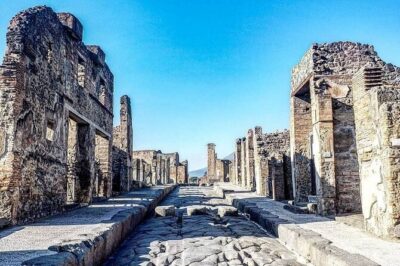
Pompeii Express Guided Tour by Train from Sorrento
Read our review →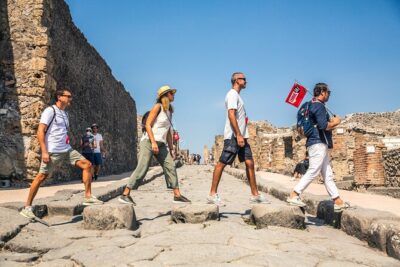
Skip-the-Line Pompeii Guided Tour from Sorrento
Read our review →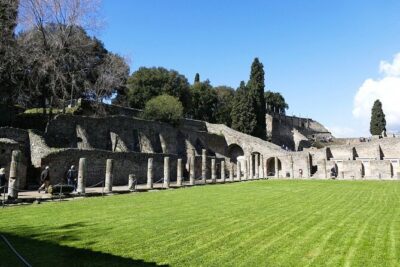
Pompeii Ruins Half-Day Tour from Sorrento with Guide
Read our review →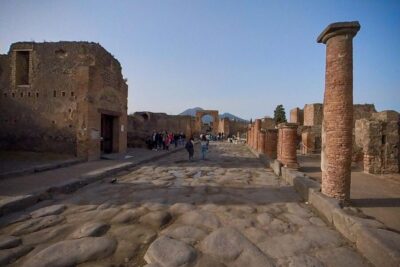
Browse the lists this tour appears in