
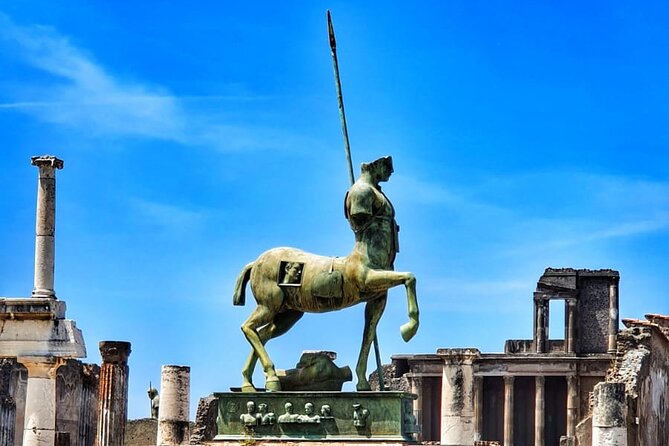
REVIEW · POMPEII TOURS
Skip the line Pompeii Guided Tour
Pompeii is too large to understand by simply wandering in, especially on a first visit. This tour gives you a guided route through the city’s major landmarks, from the Forum and Temple of Jupiter to the Stabian Baths, brothel, and Large Theatre. I like the included entrance ticket and round-trip transport from Sorrento or Naples, two useful extras in a region where getting around can be tiring.
I also like the headsets and early half-day format, which help you hear the guide and get out before the strongest midday heat. The tradeoff is time: four hours is enough for a strong introduction, but not enough to explore every corner of Pompeii. The pace can feel brisk, and an unexpected vehicle change or stop at a shop has caused frustration for some passengers.
Key points at a glance
- Pompeii’s Forum anchors the visit: You see the city’s political, religious, and commercial center before moving into its streets and public buildings.
- A guide adds useful context: Gino has been singled out for clear, informative commentary, and headsets help you follow along.
- The route covers varied ruins: Expect temples, a food market, baths, a brothel, Via dell’Abbondanza, and a theater.
- Transport is part of the value: Pickup is available at a meeting point in Sorrento or Naples, with a 30-seat bus included.
- This is a highlights tour: You get a practical introduction, not unlimited time for independent wandering.
- Plan for a brisk visit: The Pompeii portion is about two hours with the guide, while the full experience lasts roughly four hours.
Why a guide helps at Pompeii
Pompeii can look like a jumble of broken walls until someone explains what each building did. A street is more meaningful when you know it connected the Forum with the Amphitheatre. A plain-looking room becomes more interesting when you understand that it once belonged to a bath complex, market, theater, or private home.
This tour gives you that framework. The authorized English-speaking guide leads for two hours and uses headsets, so you should not need to crowd around the guide to hear the explanation. That matters in a large archaeological site where groups can spread out quickly.
Gino is the guide name most clearly associated with exceptional commentary. You cannot guarantee that he will lead your departure, but the tour is designed around an English-speaking professional guide rather than a simple transfer with entrance tickets.
The guide also helps you read Pompeii at the right scale. This was not just a town frozen in disaster. It had public baths, food markets, theaters, religious buildings, commercial streets, and formal civic spaces. The route shows how these pieces fitted together.
More Pompeii tours from Sorrento:
- Sorrento: Skip-the-Line Pompeii Express Tour by Train
★ 4.8 · 2,038 reviews - Priority Access Pompeii & Mt. Vesuvius Full day from Sorrento
★ 4.5 · 1,376 reviews - Pompeii Express Guided Tour by Train from Sorrento
★ 4.5 · 770 reviews
Reaching Pompeii from Sorrento or Naples
The tour includes pickup at a meeting point in Sorrento or Naples and transport in a 30-seat bus. That makes this a sensible choice if you are staying on the Sorrento Peninsula and do not want to manage a separate train journey, local transfer, and Pompeii admission.
The transportation is also one reason the $96.38 price can make sense. You are paying for more than the ruins themselves. The fare includes transport, the Pompeii entrance ticket, a guide for two hours, and headsets.
There is one practical caution. The planned vehicle has not always been the vehicle used. A mechanical problem once led to a private minivan for a group of five, followed by a wait while the larger group was organized. The operator said the change was made to avoid canceling the visit, but the result was confusion and less time at the site.
A shop stop has also been part of the logistics in at least one disrupted departure. I would not treat that as the main purpose of the tour, but you should keep your schedule flexible rather than placing an important appointment immediately afterward.
The tour allows up to 100 participants, even though the included transport is described as a 30-seat bus. That means the overall departure can be larger than one vehicle, with groups divided among transport or guides. If you prefer a quiet private visit, this is not that kind of experience.
Entering the Archaeological Park
The main Pompeii visit lasts about two hours, with several stops inside the archaeological park. The admission ticket is included, which removes one task from your arrival and supports the skip-the-line format promoted for the tour.
Pompeii is a vast site, and much of it remains under excavation or is not part of this short route. Two hours will not let you see every street, house, or fresco. What you get instead is a planned circuit through some of the city’s most important public places.
That structure is useful on a first visit. You see the major civic center, follow an ancient commercial road, visit public baths and a market, then finish with entertainment and less formal aspects of city life. The route gives you a picture of how people worked, worshipped, bathed, shopped, and watched performances.
Bring patience for uneven ancient paving and a willingness to keep moving with the group. The tour is designed to cover ground, not to pause for long independent study at every building.
The Forum and Temple of Jupiter
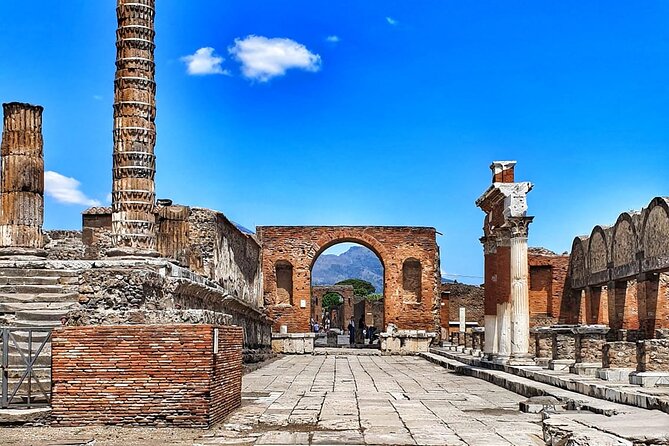
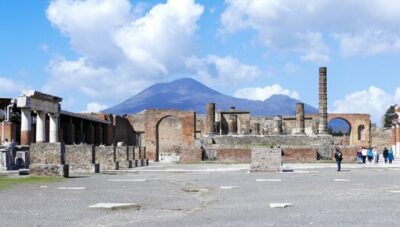
The Civil Forum was the heart of Pompeii’s public life. Government offices, justice, business, markets, and religious buildings faced this large open space. Standing here helps you understand that the Forum was not simply a scenic plaza. It was where the city conducted its official business.
The Forum stop lasts about 10 minutes, so the guide’s explanation matters. Without context, the surrounding columns and walls can blur together. With a short explanation, you can begin to separate civic buildings from religious spaces and imagine the square as a working part of town.
Next comes the Temple of Jupiter, which occupies the northern side of the Forum. Mount Vesuvius rises behind it, creating one of the strongest views on the route. The temple became a Capitolium after the Roman colony was established in 80 BC, with worship dedicated to Jupiter, Juno, and Minerva.
This is a good example of why a guided visit helps. The remains do not simply show a temple. They also show Pompeii’s connection to Roman political and religious traditions. The stop lasts about 15 minutes, enough for an explanation and a look at the setting, but not for prolonged photography or quiet reflection.
More skip-the-line entries near Sorrento:
- Skip-the-Line Pompeii Guided Tour from Sorrento
★ 4.5 · 722 reviews - From Sorrento: Pompeii Half-Day Skip-the-Line Tour
★ 4.6 · 541 reviews - From Naples: Pompeii Skip-the-Line Guided Tour
★ 4.5 · 154 reviews - Sorrento: Pompeii & Herculaneum Tour with Skip-the-Line
★ 4.6 · 125 reviews
The Macellum and Via dell’Abbondanza
The Macellum was Pompeii’s city market, located northeast of the Forum. Its porticoes and rooms were arranged around a central complex, with a raised hall for worship on the eastern side. This was a place for buying food, not just a grand monument for ceremonies.
The market’s decoration included scenes of daily life, including fish and poultry sales, along with mythological subjects. That combination is useful because it connects ordinary shopping with the visual culture of the ancient city.
The scheduled stop is about 15 minutes. You will get the building’s purpose and layout, but you should not expect time to inspect every decorative detail at length.
The route then reaches Via dell’Abbondanza, one of Pompeii’s main streets. It connected the Forum with the Amphitheatre, making it a helpful place to imagine movement through the city. A walk along this road shifts the experience from grand public spaces to the practical street network that linked them.
The stop is listed at about 10 minutes. Watch your footing and stay close to the guide, since a street may look easy to cross but can slow a group when the paving is uneven.
The Stabian Baths and Roman daily life
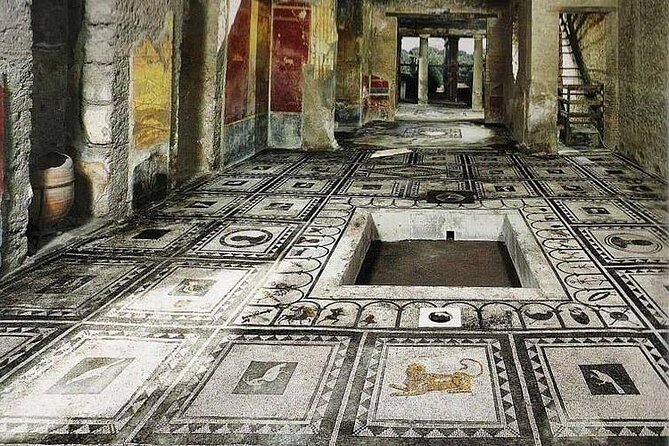
The Stabian Baths are among the most useful stops for understanding ordinary Roman routines. The complex developed in stages, with an early construction phase dating to the fourth century BC. Its large courtyard led to separate men’s and women’s areas.
The men’s section included a dressing room, cold bath, warm bath, and hot bath. The women’s section followed the same general sequence but was smaller and less richly decorated. This arrangement lets you see that Roman bathing was not just about washing. It was a social and organized public activity.
The baths were heated through hot air circulating in the walls and beneath double floors. That technical detail is easy to miss when exploring alone. A guide can point out how the Roman heating system worked and why the rooms were arranged in a particular order.
The stop lasts about 15 minutes. That is enough to understand the system, but the pace may frustrate you if you enjoy architectural details or want to study the construction closely.
The brothel and the less polished side of Pompeii
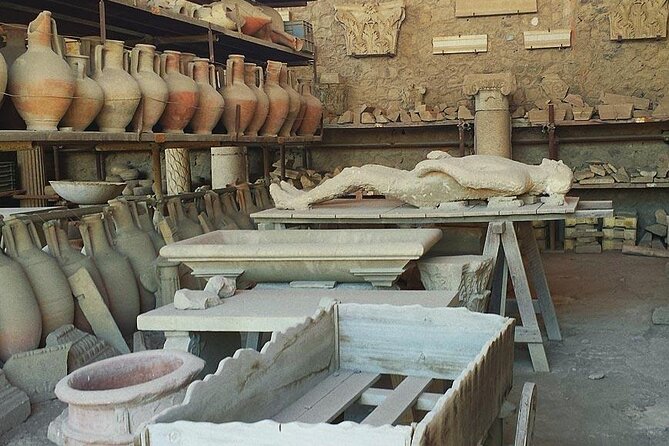
The brothel is one of Pompeii’s best-known buildings, partly because of its erotic paintings and compact rooms. The lower level contained five small rooms with built-in beds, while the upper floor included living areas for the owner and enslaved workers.
The building reflects a difficult part of Roman society. The prostitutes were mostly Greek and Oriental slaves, so the site should not be treated as a light or comic curiosity. A good guide can place the building within the realities of slavery, commerce, and sexual exploitation in the ancient city.
The stop lasts about 15 minutes. It is a short visit, and access or movement through this famous building can be more restricted than a broad public street. Your guide will help explain what you are seeing without turning the stop into mere spectacle.
For many people, this is a memorable part of the route because it makes Pompeii feel like a real city with ordinary, uncomfortable, and human aspects, not just a collection of temples.
Finishing at the Large Theatre
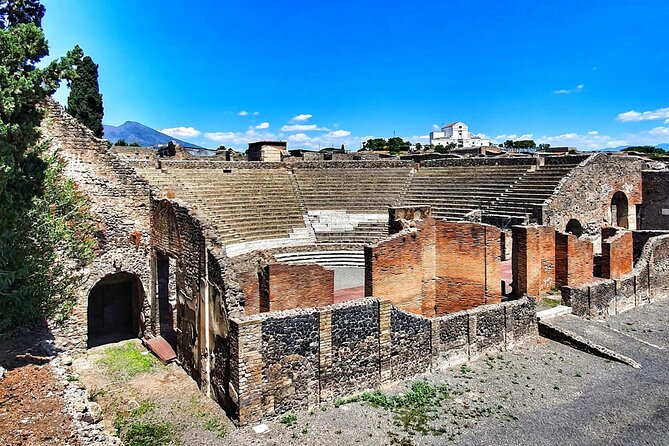
The Large Theatre was built around the middle of the second century BC and later restored in Roman style. It hosted comedies and tragedies drawn from Greek and Roman traditions.
The theater was the first major public building at Pompeii to be cleared completely from the deposits left by the eruption. Its scale gives the tour a strong finish. After seeing civic buildings, shops, baths, and a brothel, you end in a place built for shared entertainment.
The stop is about 15 minutes. You will have time to understand the theater’s purpose and layout, but not necessarily to linger alone. The guide’s explanation helps you picture how performances fit into public life.
Is $96.38 good value?
At $96.38 per person, this is not the cheapest way to enter Pompeii. The value depends on what you need.
I find the price easier to justify if you are based in Sorrento or Naples and want a single organized half-day. Transport, admission, a two-hour guide, and headsets are all included. You also avoid the work of building your own route through a very large site.
The cost is less attractive if you want to spend most of the day at Pompeii. The guided portion is only about two hours, and the overall tour lasts roughly four hours. Independent admission would give you more freedom to set your own pace, though you would need to arrange transportation and decide how to understand the site.
The strongest value here is convenience with context. You get a clear introduction and the major sights without having to manage every connection yourself. The weakest value is for repeat visitors, serious archaeology fans, or anyone who wants to linger at houses, mosaics, and side streets.
Who should book this Pompeii tour?
I would choose this tour if you are visiting Pompeii for the first time, staying in Sorrento or Naples, and want a guided overview without spending a full day there. It also suits families who prefer a planned route and included transport.
The early format can be helpful in hot weather. One family with very young children found the early departure useful before lunchtime heat, and the staff helped look after a pram while the adults carried the children through the ruins. That does not turn the site into an easy stroll, but it suggests the organized format can help families manage the visit.
You should think twice if you want to wander alone, shop before departure, or examine every building. The route can move quickly, and a transport change or delay may reduce time inside the ruins.
The tour is offered in English. Most people can participate, and the meeting point is near public transportation, but the information provided does not promise a specific accessibility arrangement beyond the general participation guidance.
Free cancellation is available up to 24 hours before the start time for a full refund. Changes made inside that 24-hour window are not accepted, and poor weather can lead to a new date or a full refund.
My call: a useful first look, not the final word on Pompeii
Book this tour if you want a well-organized introduction, included transport, and a guide to explain why Pompeii’s streets and buildings matter. The Forum, Temple of Jupiter, baths, market, brothel, and theater form a strong route through the city’s public and private life.
Skip it if your main goal is unhurried exploration. Four hours is a practical taste, not a complete Pompeii day. For most first-time visitors with limited time in Sorrento, I think the convenience and guided context are worth considering, as long as you accept the brisk pace and keep your schedule after the tour open.
FAQ
Where does the Pompeii guided tour depart from?
Pickup is available at a meeting point in Sorrento or Naples.
How long does the experience last?
The tour lasts approximately four hours.
How long is the guided visit inside Pompeii?
The authorized English-speaking guide leads for about two hours.
Is the Pompeii entrance ticket included?
Yes, the entrance ticket to Pompeii is included.
Is transportation included?
Yes, transport in a 30-seat bus is included.
Is the tour offered in English?
Yes, the tour is offered in English.
Are headsets provided?
Yes, headsets are included so you can hear the guide clearly.
Is lunch included?
No. Lunch is not included in the tour price.
What happens if I need to cancel?
You can cancel at least 24 hours before the experience start time for a full refund. Cancellations or changes made less than 24 hours before the start time are not accepted for a refund.
New on the Sorrento list
- Vico Equense: Authentic Cooking Class at a Local’s Home★ 5.0 · 4 reviews
- Vico Equense: Dining Experience at a Local’s Home★ 5.0 · 4 reviews
- Vico Equense: Tour in the dairy “Mozzarella Experience”★ 5.0 · 19 reviews
- Private tour of Amalfi Coast★ 5.0 · 71 reviews
- Private Virtual Cooking Class from Sorrento★ 5.0 · 25 reviews
- Sorrentomaxiboat tours to Capri★ 5.0 · 63 reviews
- Private transfer from Salerno to the Amalfi Coast, or vice versa★ 5.0 · 30 reviews
- Yoga Experience – Sorrento★ 5.0 · 29 reviews
Pompeii Tours, compared.
Priority Access Pompeii & Mt. Vesuvius Full day from Sorrento
Read our review →
Pompeii Express Guided Tour by Train from Sorrento
Read our review →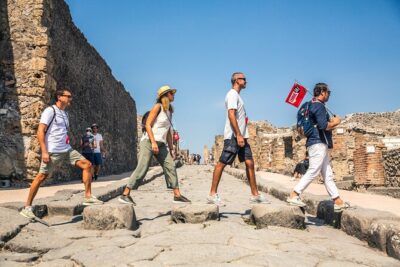
Skip-the-Line Pompeii Guided Tour from Sorrento
Read our review →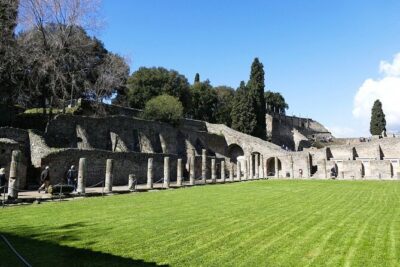
Pompeii Ruins Half-Day Tour from Sorrento with Guide
Read our review →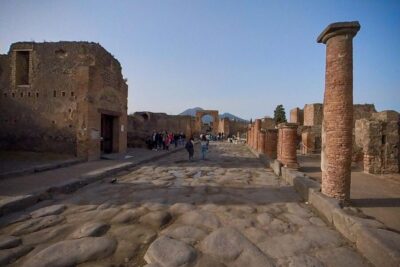
Browse the lists this tour appears in