
REVIEW · POMPEII TOURS
Guided Tour of Pompeii and Herculaneum with Lunch and Ticket
Pompeii and Herculaneum tell the same volcanic story in very different ways. This tour lets you see both in one long day from Sorrento, then breaks up the ruins with a local winery lunch on the slopes of Vesuvius. At Pompeii, you walk broad streets and public buildings. At Herculaneum, you see smaller homes with remarkable mosaics and frescoes.
I like the way the tour pairs two archaeological sites rather than treating Pompeii as a standalone photo stop. I also like the practical setup: admission is included, transport is arranged, and the meal includes bruschetta, cured meats, cheeses, pasta, dessert, and three wines.
The tradeoff is pace. You have roughly two hours at each site, and Pompeii can be crowded. One guide has been praised for making time for shade in hot weather, while another departure felt rushed and had trouble locating the guide in the crowd. This is a useful, efficient introduction, not a slow archaeological study.
Key points at a glance
- Two famous Roman sites in one day: Compare Pompeii’s wide streets and public spaces with Herculaneum’s unusually well-preserved houses.
- A winery stop with a proper meal: Taste Prosecco, red, and white wines with local food, including pasta with Piennolo cherry tomatoes.
- Site-focused guiding: Guides such as Celsestina at Pompeii and Diana at Herculaneum have been praised for clear explanations and engaging stories, but staff can vary.
- A demanding nine-hour schedule: Expect plenty of walking, heat, crowds, and limited time at each ruin.
- Good value for a packed day: The $192.22 price includes transportation, admission to both sites, lunch, and wine tasting.
- Best for first-time visitors: You get a strong overview without having to arrange two archaeological parks yourself.
Why see Pompeii and Herculaneum together?
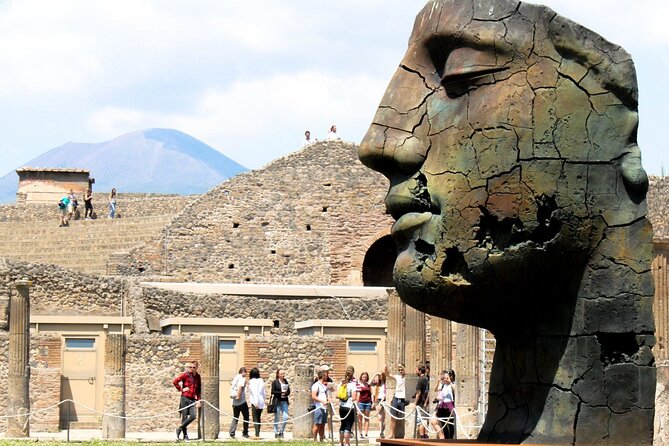
Pompeii and Herculaneum were both buried by the eruption of Mount Vesuvius in 79 AD, but the sites give you different views of Roman life.
Pompeii was a substantial city with commercial streets, public baths, theaters, markets, temples, and an amphitheater. Its scale helps you understand how a Roman town worked. You can walk along Via dell’Abbondanza, picture shopkeepers serving customers, and see how public life gathered around the Forum.
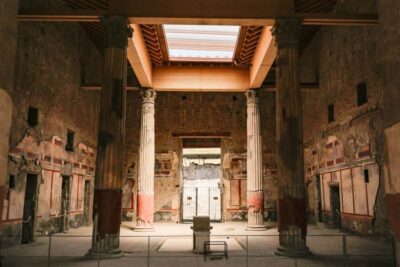
Herculaneum was smaller and more residential. The preservation is often more intimate. Houses retain colorful wall decoration, mosaic floors, woodwork, and domestic details that help you picture the people who lived there.
I think the pairing is the strongest reason to book this excursion. If you see only Pompeii, you may leave with a sense of scale but miss the quieter domestic detail. If you see only Herculaneum, you miss the grand civic spaces. In one day, the contrast becomes part of the lesson.
The schedule is not leisurely. Each archaeological park receives about two hours, with travel and lunch between them. You will not see every open building. Instead, you get a guided route through key places, with enough context to make the stones and walls meaningful.
More Herculaneum tours from Sorrento:
- Guided Day Tour of Pompeii and Herculaneum with Light Lunch
★ 4.5 · 311 reviews - Sorrento: Pompeii & Herculaneum Tour with Skip-the-Line
★ 4.6 · 125 reviews - Pompeii, Herculaneum and Winery on Vesuvius with an Archaeologist
★ 5.0 · 89 reviews
Starting in Pompeii’s public heart
The Pompeii portion begins at the Archaeological Park of Pompeii, where admission is included. The site is large, and its open streets can make the first moments feel confusing. A guide matters here because it helps you understand what belongs to a temple, market, bath complex, or private home.
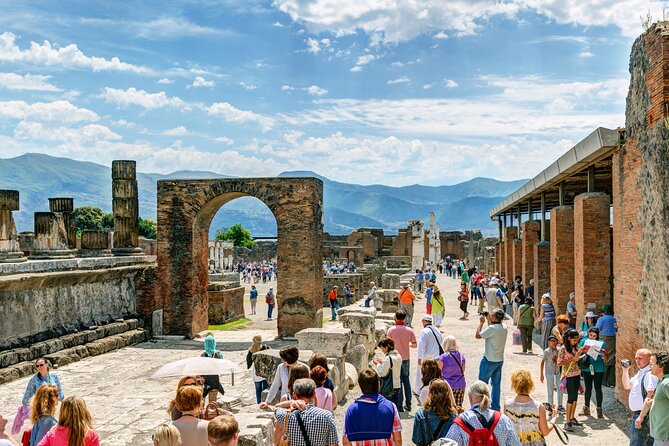
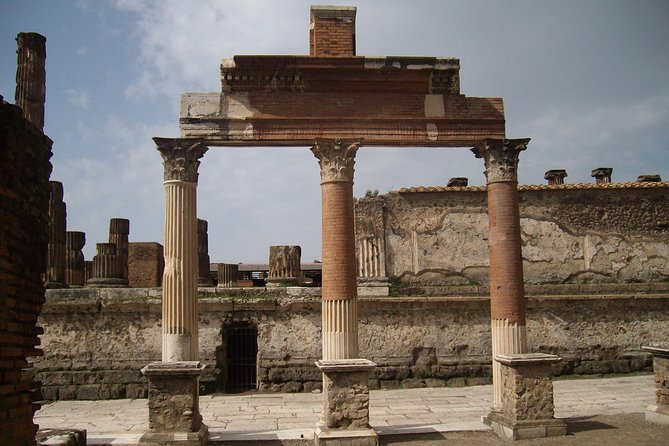
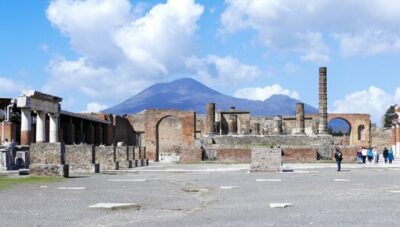
The Civil Forum was the city’s center for politics, justice, business, worship, and ordinary public activity. It is a good starting point because the surrounding buildings show how many parts of Roman life met in one square.
At the northern end, the Temple of Jupiter frames the Forum. Mount Vesuvius rises behind it, creating one of the clearest visual reminders of the disaster that buried the city. After Pompeii became a Roman colony in 80 BC, the temple was rebuilt as a Capitolium dedicated to Jupiter, Juno, and Minerva.
The nearby Macellum was the city market. Its porticoes sheltered commercial activity, while the walls carried scenes linked to daily life and mythology. This stop helps you picture Pompeii as a working city rather than a silent collection of ruins.
Walking Via dell’Abbondanza
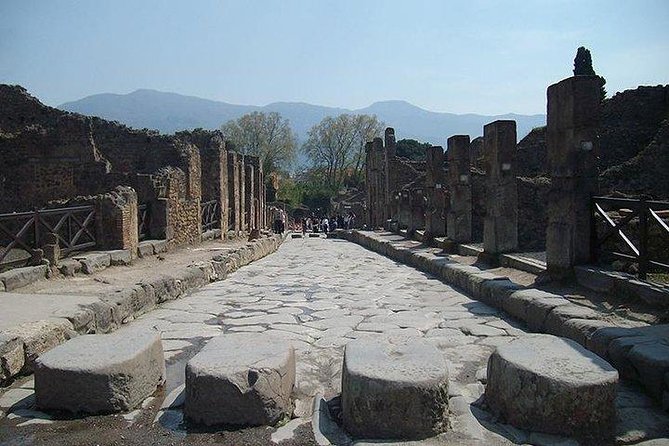
Via dell’Abbondanza connected the Forum with the amphitheater and was one of Pompeii’s main streets. You can expect uneven paving, exposed sun, and a fair amount of walking as the route moves between buildings.
The street is valuable because it connects the public center with ordinary movement through town. Look for the way houses, shops, and public structures fit into the same urban grid. You are not simply looking at isolated monuments. You are tracing a route people used for business, bathing, errands, and entertainment.
The tour also visits the Stabian Baths, one of Pompeii’s most useful places for understanding Roman social life. The complex included changing rooms, cold rooms, warm rooms, and hot rooms. Heating came through hot air moving beneath floors and through wall systems.
The baths were not just for washing. People talked politics, legal disputes, military affairs, and private matters there. The men’s section was larger and more decorated, while the women’s section was smaller. A guide can make these practical details easier to grasp than a sign alone.
The Lupanar and Teatro Grande
The Lupanar is one of Pompeii’s best-known buildings. It was a brothel with five small rooms on the lower floor, each fitted with a built-in bed. Erotic paintings remain inside, and the building also had an upper level connected with the owner’s and enslaved workers’ quarters.
This stop can attract a crowd, so your time inside may feel brief. It is also a reminder that Pompeii was a real town with commercial sex, slavery, and blunt evidence of everyday life, not a polished Roman fantasy.
The Teatro Grande offers a different mood. Built around the middle of the second century BC and later adapted in Roman style, it hosted Greek and Roman comedies and tragedies. The theater was the first major public building at Pompeii to be cleared fully of eruption deposits.
I would pay attention to the shape of the seating and stage rather than rushing through for a photograph. The theater helps explain how entertainment, social status, and civic identity worked in the ancient city.
More Pompeii tours from Sorrento:
- Sorrento: Skip-the-Line Pompeii Express Tour by Train
★ 4.8 · 2,038 reviews - Priority Access Pompeii & Mt. Vesuvius Full day from Sorrento
★ 4.5 · 1,376 reviews - Pompeii Express Guided Tour by Train from Sorrento
★ 4.5 · 770 reviews - Skip-the-Line Pompeii Guided Tour from Sorrento
★ 4.5 · 722 reviews
Lunch and wine on the slopes of Vesuvius
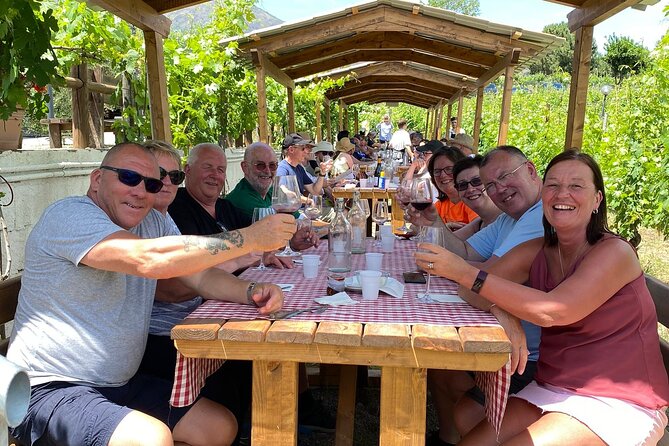
Between the two archaeological sites, the tour stops at Sorrentino Vini. The winery has 35 hectares within Vesuvius National Park and is known for Lacryma Christi, the local DOC wine associated with the volcano.
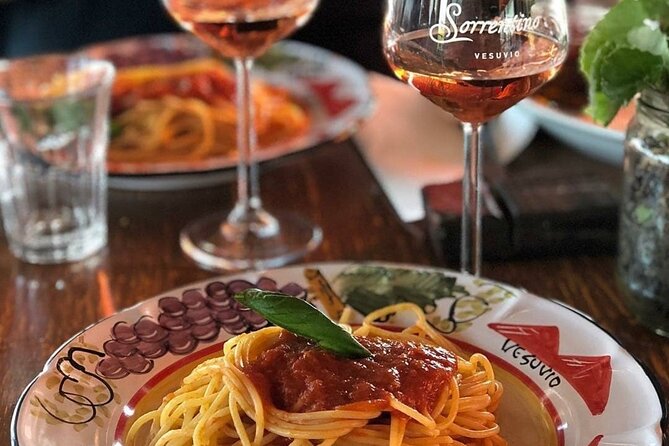
Lunch includes bruschetta, cured meats, cheeses, seasonal vegetables, pasta with Piennolo cherry tomatoes, and a traditional homemade dessert. You also taste three wines: Prosecco, red, and white.
This is more than a snack in the middle of a busy day. Pompeii and Herculaneum both require walking, and a seated meal gives you a chance to recover before the second site. The food also adds a local connection that a packed sandwich would not provide.
Still, time is the issue. If you want the longest possible visit inside both ruins, you may see the winery stop as time taken away from archaeology. The tour deliberately includes a relaxing meal, so book it if you value a full regional experience rather than a site-only schedule.
Herculaneum’s smaller scale and finer detail
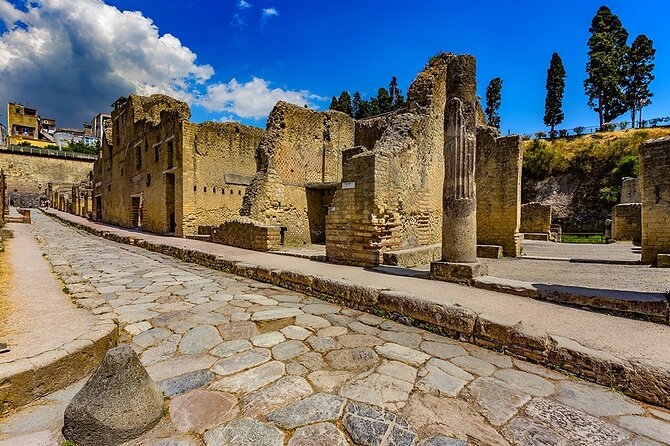
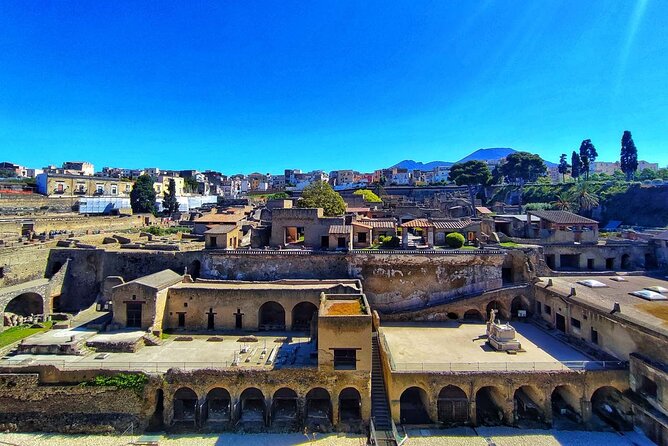
Herculaneum is the afternoon contrast to Pompeii. The ancient town was smaller, but the remains of houses and villas are often strikingly preserved. You can expect another two-hour visit, with uneven paths and more walking after lunch.
The House of the Deer is a luxurious residence with a terrace overlooking the sea. Its name comes from garden statues showing deer attacked by dogs. The house belonged to Quintus Granius Verus, a freed slave, which adds a useful reminder that wealth and social advancement were possible in complex ways within Roman society.
The House of Neptune and Amphitrite is one of Herculaneum’s visual highlights. Its glass-paste mosaics show floral and hunting scenes, with Neptune and Amphitrite at the center. The materials were expensive for their time, and the decoration gives you a sense of the owner’s taste and resources.
The House of the Skeleton takes its name from human remains found in an upstairs room in 1831. It may have formed from three smaller buildings joined together. Its layout is a good example of how private residences changed over time rather than appearing all at once as perfectly planned homes.
Frescoes, civic life, and the House of the Hotel
The Sacellum of the Augustales was a shrine linked to the worship of the emperor. Its frescoes show Hercules entering Olympus with Jupiter, Juno, and Minerva, along with Hercules fighting Achelous. A caretaker’s skeleton was found in a room, an unsettling detail that brings the eruption close to home.
The House of the Hotel is the largest house discovered at Herculaneum, covering about 2,150 square meters. Its panoramic position and private bath district once led excavators to think it had been a hotel. The name remains, though its original function was not a hotel in the modern sense.
The House of the Black Salon gets its name from a party room painted black with geometric designs. Waxed tablets belonging to L. Venidius Ennychus were found there. They refer to his eligibility for the Augustales, the purchase of a slave, and the birth of a daughter.
These details are where Herculaneum earns its place in the itinerary. You see grand rooms, but you also get fragments of names, family events, status, and household business. The ancient world becomes less abstract.
How the guides shape the day
Guiding is especially important at these sites because the ruins do not always explain themselves. On some departures, Celsestina has led the Pompeii visit and Diana the Herculaneum visit. Celsestina has been praised for explaining daily activities in a way that makes the city easier to picture, while Diana has been noted for her stories and clear comparison between the two parks.
You should also know that the guide experience can vary. One departure had trouble keeping the guide visible in crowded Pompeii, and the route felt rushed at both sites. Pompeii’s crowds are not fully under the operator’s control, but a clear meeting point and a visible guide make a real difference.
The tour may be operated by a multilingual guide, although it is offered in English. If you need every explanation in English, confirm the language arrangement before booking. The strongest departures appear to depend on guides who manage both content and pace well.
Price, transport, and physical demands
At $192.22 per person, this is not a budget museum outing. The price includes both archaeological admissions, transportation from the Sorrento area, lunch, and three wine tastings. When you add up two site tickets, a winery meal, and the convenience of not arranging separate transfers, the cost is reasonable for a tightly organized full day.
The vehicle has been described as an air-conditioned van or minibus on some departures. The stated maximum is 100 people, so the actual group may be much smaller or may involve a larger coach arrangement. Either way, you should expect a group tour rather than private guiding.
The full duration is about nine hours, but traffic can change the timing. Wear comfortable shoes. In summer, add sunglasses, sunscreen, and a hat if you have one. Shade is limited in parts of Pompeii, and the combination of sun, uneven ground, and two parks can leave you tired.
The tour is near public transportation, and most people can participate. That does not mean it is effortless. If you have trouble with extended walking or uneven surfaces, ask the provider for current practical details before booking.
Who should book this Pompeii and Herculaneum tour?
I would choose this tour if you are staying in Sorrento and want to see both sites without managing trains, tickets, transfers, and lunch yourself. It is especially useful for a first visit, when a guide can point out what matters before the ruins begin to blur together.
It also suits you if food and wine are part of your idea of a good day. The winery stop is not filler for everyone. It provides a regional meal and a pause between two demanding visits.
I would hesitate if you want to spend half a day at Pompeii alone. The park is huge, and two hours only covers a selected route. A serious archaeology fan may prefer a dedicated Pompeii tour with more time and fewer fixed stops.
I would also think twice if heat, crowds, or long walking days wear you down. The schedule is efficient, but it is not gentle. The best way to enjoy it is to accept that you will see highlights, not every corner.
Should you book it?
Book this experience if you want a practical one-day comparison of Pompeii and Herculaneum, with the hard work of transportation and admissions handled for you. The combination of the Forum, baths, Lupanar, theater, Herculaneum houses, winery meal, and Vesuvius wines gives you a broad picture of the region.
Skip it in favor of separate visits if you want a slower pace or detailed study of one site. For most first-time visitors based in Sorrento, though, the tour offers a sensible balance of ancient streets, domestic interiors, local food, and volcanic scenery. Free cancellation is available up to 24 hours before departure, and poor weather may lead to a new date or a full refund.
FAQ
How long does the tour last?
The tour lasts approximately nine hours, although the schedule can change because of traffic or other local conditions.
Are Pompeii and Herculaneum admission tickets included?
Yes. Admission to both archaeological parks is included in the tour price.
Is lunch included?
Yes. Lunch includes bruschetta, cured meats, cheeses, seasonal vegetables, pasta with Piennolo cherry tomatoes, and a traditional homemade dessert.
How many wines are included?
The winery tasting includes three wines: Prosecco, red wine, and white wine.
Is the tour offered in English?
The experience is offered in English, although it may be operated by a multilingual guide.
How much walking should I expect?
You should expect substantial walking on uneven archaeological paths at both sites. Comfortable shoes are recommended, along with sunglasses and sunscreen in summer.
Can I cancel for a full refund?
You can cancel at least 24 hours before the experience start time for a full refund. Changes or cancellations made less than 24 hours before the start time are not accepted for a refund.
More tours that include lunch in Sorrento
- Capri Boat Tour from Sorrento: Swim, Grottos & Light Lunch
★ 5.0 · 1,201 reviews - Amalfi Coast Day Tour from Sorrento with Light Lunch and Wine
★ 4.5 · 1,148 reviews - From Sorrento: Pompeii and Vesuvius Guided Tour with Lunch
★ 4.8 · 683 reviews - Positano & Amalfi Boat Tour from Sorrento: Swim & Light Lunch
★ 5.0 · 399 reviews
New on the Sorrento list
- Vico Equense: Tour in the dairy “Mozzarella Experience”★ 5.0 · 19 reviews
- Vico Equense: Authentic Cooking Class at a Local’s Home★ 5.0 · 4 reviews
- Vico Equense: Dining Experience at a Local’s Home★ 5.0 · 4 reviews
- Private tour of Amalfi Coast★ 5.0 · 71 reviews
- Private Virtual Cooking Class from Sorrento★ 5.0 · 25 reviews
- Sorrentomaxiboat tours to Capri★ 5.0 · 63 reviews
- Private transfer from Salerno to the Amalfi Coast, or vice versa★ 5.0 · 30 reviews
- Yoga Experience – Sorrento★ 5.0 · 29 reviews
Pompeii Tours, compared.
Priority Access Pompeii & Mt. Vesuvius Full day from Sorrento
Read our review →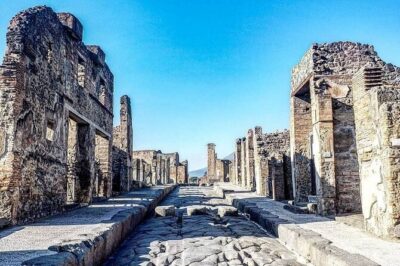
Pompeii Express Guided Tour by Train from Sorrento
Read our review →
Skip-the-Line Pompeii Guided Tour from Sorrento
Read our review →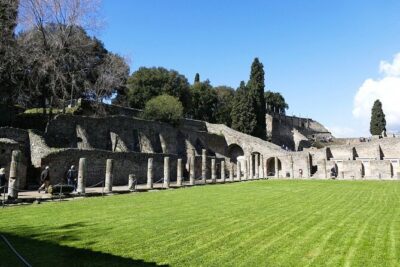
Pompeii Ruins Half-Day Tour from Sorrento with Guide
Read our review →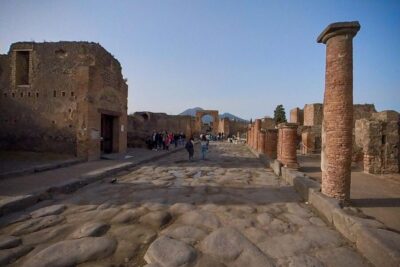
Browse the lists this tour appears in