

REVIEW · HERCULANEUM TOURS
Transfer from Naples to Positano with 2 hours Private Tour in Herculaneum
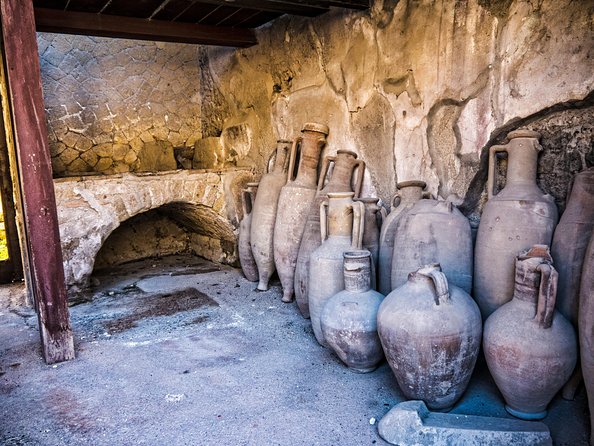
Herculaneum is the clever stop here. Instead of spending your Naples-to-Positano transfer sitting in a station or bus, you pause at a remarkably preserved Roman town, then continue by private vehicle to the Amalfi Coast. The archaeological visit gives the transfer real substance, while your driver stays with the vehicle and luggage.
I like the door-to-door pickup and the calm convenience of an air-conditioned minivan. I also like that the Herculaneum visit is led by a professional guide, with Laura singled out for her strong grasp of ancient Roman history. The main drawback is cost: at $456.70 per person, this makes the most sense when you value privacy, time, and a guided visit more than the cheapest possible ride.
Key points at a glance
- Two useful travel jobs in one: You get from Naples to Positano and visit Herculaneum without arranging separate transport.
- Private pickup in Naples: Choose the time and location for pickup, then finish with hotel drop-off in Positano.
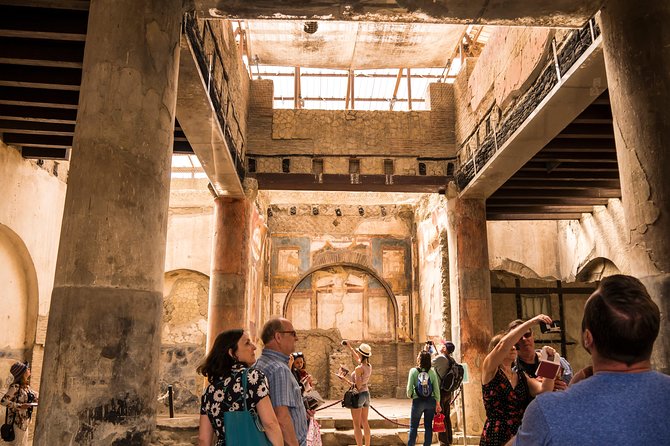
- A focused archaeological visit: The tour covers major homes, public buildings, baths, and streets within about two hours.
- Your luggage stays with the vehicle: The driver remains with the minivan while you tour the ruins.
- A shorter alternative to Pompeii: Herculaneum is smaller than Pompeii but offers exceptionally clear views of domestic Roman life.
- Good for a tight itinerary: The full experience lasts about four hours, with transport and entry tickets included.
Why this transfer works better than a plain ride
A Naples-to-Positano transfer can easily become a tiresome chain of trains, buses, and luggage handling. This option keeps the journey in one private vehicle and adds a serious cultural stop along the way.
You arrange pickup at the Naples location and time you choose. From there, a professional driver takes you toward Herculaneum in an air-conditioned minivan. Your bags remain in the vehicle while you visit the ruins, and the same service continues to your Positano hotel.
That setup matters most on a travel day. You do not need to find a station, change vehicles, or work out how to manage luggage during the archaeological visit. You can give your attention to the site instead of guarding suitcases.
The advertised duration is about four hours, including the Herculaneum visit and the transfer to Positano. The exact feel of the day depends on the pickup point and road conditions, so I would keep your arrival plans in Positano reasonably flexible.
More Private Transfers in Positano
- Private Transfer from Positano to Naples
★ 5.0 · 87 reviews - Private Transfer From Positano Hotels to Naples
★ 5.0 · 50 reviews - Private Transfer from Positano to Naples
★ 5.0 · 40 reviews
Meeting your guide at Herculaneum
At Herculaneum, you meet the guide at the archaeological park ticket office. Entry is included, as is assistance from a professional guide. The guided portion is planned for about two hours.
That is a useful amount of time here. Herculaneum is smaller than Pompeii, so you can examine individual houses and details without trying to cover an enormous city. The guide helps you read the ruins as homes, businesses, public spaces, and religious buildings rather than as a collection of old walls.
One guide named in the experience is Laura. Her focus is ancient Roman history, and the personal nature of the tour means your group can follow the explanation at a more comfortable pace than on a large group visit.
The stop is not a quick photo break. You see a sequence of significant buildings, with time allocated to each. The listed schedule gives about 15 minutes to most sites, enough for explanation and a close look, though not enough for every room and detail.
Casa dei Cervi and the seaside houses
Casa dei Cervi, or the House of the Deer, takes its name from marble statues of stags found in the peristyle. A peristyle is an open courtyard surrounded by columns, a familiar feature in large Roman homes.
This house gives you an early sense of the town’s wealth. The statues and layout point to a private residence designed for display as well as daily life. I find details such as the deer more memorable than a long list of dates because they show how Roman owners decorated their homes.
Next comes the terrace of Marcus Nonius Balbus. Balbus was an important benefactor who funded public buildings and restoration work in Herculaneum. After his death, the city honored him with a funeral altar and a long inscription describing his status and honors.
This stop connects private wealth with civic life. You are not just looking at an ancient home. You are seeing how a prominent citizen could shape a Roman town through public generosity and gain lasting recognition in return.
The Augustales and the public face of Herculaneum
The College of the Augustales was linked to the cult of Emperor Augustus. It may also have served as the headquarters of the local Augustales or perhaps the town’s curia, a civic administrative center.
The uncertainty about its exact use is worth hearing. Archaeological sites do not always come with neat labels, and a good guide can explain what is known, what is likely, and what remains open to interpretation.
This building also helps balance the home-focused parts of the visit. Herculaneum was not only a place of villas and courtyards. It had religious, civic, and social institutions that tied the community together.
The Casa del Rilievo di Telefo provides another look at an imposing private residence. It may have belonged to Marcus Nonius Balbus or someone in his circle. Its unusual feature is a private access point to the neighboring Suburban Thermae, or baths.
That connection tells you something about Roman comfort and status. A private entrance to a bathing complex was not an ordinary household feature. It suggests a house designed around access, display, and leisure.
More days out that start in Naples:
- PRIVATE DAY TOUR OF AMALFI COAST from Naples/Salerno/Sorrento or Positano
★ 5.0 · 62 reviews - From Naples: Private Tour to Sorrento, Positano, and Amalfi
★ 4.9 · 42 reviews - Transfer From Naples airport or station to Positano and vice versa
★ 5.0 · 28 reviews - Positano, Amalfi and Ravello by Mercedes Van from Naples
★ 4.5 · 13 reviews
Carbonized wood and the House of the Skeleton
The House of the Wooden Partition is important because part of its elegant wooden divider survived. At Herculaneum, carbonized wood can remain visible where similar material disappeared entirely at other Roman sites.
This is one of the strongest reasons to choose Herculaneum. You see not just stone foundations and painted plaster, but traces of the wooden fittings that helped make a Roman house feel finished and comfortable. The survival of a partition brings the building closer to everyday life.
The House of the Skeleton has a more somber name. It appears to have formed through the combination of three smaller buildings. Its name comes from human remains found in a second-floor room in 1831.
The site is a reminder that Herculaneum is also a disaster site, not only an architectural one. You may prefer to spend more time on the house’s structure and less on the discovery itself, but the guide can place the name in its archaeological context.
The schedule gives about 15 minutes to each of these houses. That is enough for a guided overview, but anyone who enjoys detailed photography or wants to study every fresco should know this is a structured visit, not an open-ended exploration.
Roman bathing at the Central Thermae
The Central Thermae were built around the beginning of the first century AD. As was common in Roman towns, the bath complex had separate sections and entrances for men and women.
Baths were central to Roman public life. They provided washing facilities, but they also served as places for social contact and routine. Seeing the Central Thermae helps you understand the town as a working community, with public services supporting daily life.
The stop also changes the rhythm of the tour. After several private houses, you move into a building designed for shared use. The contrast is useful: the homes show individual taste and status, while the baths show the systems that served the wider town.
The Black Hall and Samnite House
The Casa del Salone Nero, or House of the Black Hall, is one of Herculaneum’s more luxurious residences. Its monumental entrance still preserves carbonized remains of the doorposts and lintel.
That doorway is the kind of detail I would pay attention to. It lets you see how much of a Roman house could be made from wood, and how the destruction preserved materials that normally would have vanished. The entrance also signals the status of the people who lived there.
Casa Sannitica has a different character. Its splendid atrium is bordered by a gallery with Ionic columns, and the rooms retain decorative frescoes. The arrangement is associated with the Samnites, an ancient people connected with the mountainous area of central Italy.
The house gives the guide a chance to discuss changing cultural influences in the region. You get architecture, decoration, and local identity in one stop. As with the other homes, the focus is on what survives and what it suggests about life inside.
Bel Cortile and the Grand Portal
Casa del Bel Cortile is unusual because it lacks the standard atrium arrangement associated with many Roman houses. Instead, it has a courtyard with a stairway and a stone balcony.
That difference is useful for anyone who has begun to recognize the typical Roman house plan. Once you know what an atrium normally does, an alternative layout becomes easier to understand. The house shows that Roman domestic architecture had room for local solutions and personal choices.
The final listed stop is the House of the Grand Portal, a prominent home in the center of the archaeological area. It includes columns, frescoes, and charred remains of wooden elements.
This is a fitting last look at Herculaneum because it brings together the main themes of the visit: decorative painting, columned spaces, substantial homes, and the survival of wood after the town’s destruction. You leave with a picture of Herculaneum as a lived-in place, not simply a ruin field.
What the $456.70 price really buys
At $456.70 per person, this is not a budget transfer. The value depends heavily on how much you would otherwise spend on separate transport, entrance arrangements, and a private guided visit.
The fee includes:
- Private air-conditioned minivan transport
- One-way transfer from Naples to Positano
- Herculaneum entry tickets, listed at €16 per person
- A professional guide and assistance at Herculaneum
- Taxes
- Hotel drop-off in Positano
You are paying for time and coordination as much as for the vehicle. The driver remains with the minivan and your luggage while you tour, which removes one of the more awkward parts of combining sightseeing with a transfer.
This price makes the strongest sense for people who would already choose a private transfer. If you were planning to use public transport and skip Herculaneum, this will feel expensive. If you want a direct Naples-to-Positano ride and would also pay for a guided archaeological stop, the package becomes easier to justify.
Group discounts are available, though the amount is not specified. Since this is a private activity, only your group participates. That can make the per-person cost more reasonable for a larger party, but you should check the final group price before booking.
Practical details before you book
The experience offers pickup in Naples and hotel drop-off in Positano. You choose the pickup time and location, which is especially useful if you are staying at a hotel or arriving at a specific point in the city.
The vehicle is air-conditioned. Car seats are available on request, and service animals are allowed. The experience is near public transportation, though the whole point is that you do not need to rely on a train or bus for this transfer.
Most people can participate, according to the provided information. If you need a particular arrangement, request it before the travel date rather than assuming the vehicle can be changed at the last moment.
Meals are not included. The duration is about four hours, and the listed Herculaneum schedule includes the ticket office plus eleven major buildings or areas. I would treat the timing as a guided route with planned stops rather than free time to wander wherever you like.
Free cancellation is available up to 24 hours before the start time for a full refund. Changes or cancellations made within 24 hours are not accepted for a refund.
Who should choose this private Herculaneum transfer?
I would recommend it to anyone who wants to combine a necessary transfer with a meaningful historical stop. It is especially well suited to couples, families, or small groups who value not handling luggage through multiple transport changes.
It also suits you if Pompeii feels too large for the time available. Herculaneum offers a shorter visit with a strong focus on houses, interiors, woodwork, frescoes, and public buildings.
Families should ask for car seats when booking. History enthusiasts should be aware that the route is guided and time limited, so the experience favors a clear overview over extended independent study.
I would hesitate if your main goal is the lowest-cost way to reach Positano, or if you already have a separate Herculaneum visit planned. In those cases, you may be paying for services you do not need.
Should you book it?
Book this experience if you want a private, direct Naples-to-Positano transfer and would like to use the journey for a focused visit to Herculaneum. The best features are the door-to-door service, the luggage care, and the professional guide, with Laura named as one guide who brings strong Roman history knowledge to the visit.
Skip it if price matters more than convenience, or if four hours feels too tight for your travel day. For the right group, though, this is a smart way to turn a plain transfer into a useful cultural stop, with no need to arrange separate transport or carry your bags through the ruins.
FAQ
Where does this experience start?
Pickup is offered at a time and location in Naples chosen by you.
Where does the transfer end?
The service includes hotel drop-off in Positano.
How long does the experience last?
The total duration is approximately four hours.
How long is the Herculaneum visit?
The guided visit to Herculaneum is planned for about two hours.
Is Herculaneum admission included?
Yes. Herculaneum entry tickets are included, listed at €16 per person.
Is this a private activity?
Yes. Only your group participates in the private tour and transfer.
Can I cancel for a full refund?
Yes, if you cancel at least 24 hours before the experience start time. Cancellations made less than 24 hours in advance are not refunded.
More 2-Hour Experiences in Positano
- From Positano or Praiano: 2H Private Amalfi Coast speed tour
★ 4.5 · 9 reviews - 2 Hours Sunset Cruise of Positano
★ 5.0 · 5 reviews - Ceramic Class in Positano 2 hours workshop
★ 5.0 · 3 reviews - Capri: 2-Hour Boat Tour with Happy Hour
★ 4.8 · 286 reviews
More Herculaneum tours from Positano
- Pompeii Herculaneum small group tour from AmalfiCoast
★ 4.5 · 12 reviews - Guided Day Tour of Pompeii and Herculaneum with Light Lunch
★ 4.5 · 311 reviews - Sorrento: Pompeii & Herculaneum Tour with Skip-the-Line
★ 4.6 · 125 reviews - Pompeii, Herculaneum and Winery on Vesuvius with an Archaeologist
★ 5.0 · 89 reviews
New on the Positano list
- Amalfi Coast: Vespa Tour of Amalfi, Ravello, and Positano★ 5.0 · 23 reviews
- Positano, Amalfi & Ravello Shared Tour from Sorrento★ 4.0 · 15 reviews
- PrivateTransfer: Sorrento/Positano – Rome/Airport FCO or reverse★ 5.0 · 5 reviews
- Private Transfer from Sorrento to Positano★ 4.5 · 10 reviews
- Exclusive Private Boat Tour from Sorrento to Positano and Amalfi★ 5.0 · 6 reviews
- Private Boat Tour from Sorrento to Capri and Positano★ 5.0 · 6 reviews
- Private Scenic Boat Tour from Sorrento to Positano and Amalfi★ 5.0 · 8 reviews
- Private Boat Tour from Sorrento to Positano and Amalfi★ 5.0 · 17 reviews
Herculaneum Tours, compared.

Guided Day Tour of Pompeii and Herculaneum with Light Lunch
Read our review →

Pompeii, Herculaneum and Winery on Vesuvius with an Archaeologist
Read our review →
Pompeii & Herculaneum – Skip the line from Sorrento
Read our review →

Pompeii and Herculaneum small group excursion from Sorrento
Read our review →
Private Pompeii and Herculaneum Day Tour with Pick Up
Read our review →Browse the lists this tour appears in