
REVIEW · WINE TOURS IN SORRENTO
Private Pompeii Tour with Archaeologist & Winery on Mt Vesuvius
The best part of this day is the contrast: Pompeii’s streets, baths, theaters, and homes in the morning, followed by a relaxed meal among the vineyards of Mount Vesuvius. Archaeologist Fabrizio Belleni guides the Pompeii visit, and he can adjust the route to your interests and physical pace.
I like the private Mercedes transfer, which removes the usual train, taxi, and ticket hassle. I also like the winery stop, especially the five-wine tasting with spaghetti made from Vesuvius cherry tomatoes. The main caution is cost: the listed price is $434.46 per person, and lunch and wine add another €50 or €60 per person.
Key points
- Pompeii tailored to your pace: Fabrizio can focus on the Forum, baths, theaters, homes, bakeries, or other areas you request.
- A real archaeologist as your guide: The tour adds context about daily life, buildings, art, and Roman customs.
- Private Mercedes transport: Pickup and drop-off are available from Sorrento and Naples.
- Five wines with a local lunch: The Cantina del Vesuvio visit includes a vineyard walk, tasting, pasta, cured meats, cheese, and pastiera.
- Pompeii entry can be handled in advance: Express skip-the-line admission is included when that option is selected.
- No climb to the crater: The winery is on Mount Vesuvius, but this tour does not go to the summit.
Why the Pompeii and winery pairing works
Pompeii can be a lot to take in. The archaeological park covers about 150 acres, and the ancient city once held roughly 18,000 people. You could spend a full day here and still leave parts unseen.
This experience takes a more sensible approach. You see the main civic center, several important buildings, one or two grand houses, and a theater. Then you leave the stones behind for a family-run winery with views toward the Bay of Naples and Vesuvius.
That change of pace matters. Pompeii demands attention, with uneven paving, open courtyards, and a constant stream of visual details. The winery gives you a chair, a plate of food, and time to talk about what you have seen. I like that the day is not built around ruins alone.
The tour lasts approximately four to seven hours. The exact length depends on your chosen route, walking speed, and time at the winery. Since this is a private activity, you are not tied to a large group’s schedule.
More Wine Tours in Sorrento
- Sorrento Farm and Food Experience including Olive Oil, Limoncello, Wine tasting
★ 5.0 · 2,524 reviews - Sorrento: Pizza Lesson, Wine, and Limoncello at a Local Farm
★ 5.0 · 1,513 reviews - Amalfi Coast Day Tour from Sorrento with Light Lunch and Wine
★ 4.5 · 1,148 reviews
Fabrizio’s private approach at Pompeii

Fabrizio Belleni is the guide who leads the Pompeii visit. His role is more than pointing out old walls. He explains how the city worked, how people used its public buildings, and what small details reveal about Roman daily life.
Before the walk, you can tell him what interests you most. You might want a strong focus on architecture, religion, politics, food, private homes, or the practical side of Roman life. You can also tell him about your walking ability. One useful feature of this tour is that the route is shaped around your physical condition rather than forcing everyone into the same pace.
That flexibility is particularly helpful at Pompeii. The site is large, and the best visit is not always the one that covers the greatest distance. A focused route around the Forum can give you a clearer picture than a rushed march across the whole park.
The private format also lets you ask questions as they occur to you. If a building puzzles you, you can stop and ask. If your group is fascinated by kitchens, plumbing, theater design, or ancient commerce, you can spend more time there.
Entering through Porta Marina
Porta Marina is one of Pompeii’s most dramatic entrances. This was the city’s main access point toward the sea, with a double-arched gate designed for pedestrians and carts.
The gate is part of Pompeii’s defensive walls, so it gives you an immediate sense of the city as a real place rather than a collection of isolated ruins. From here, Via Marina leads uphill toward the Forum and the center of public life.
This is a good starting point because the route naturally moves from the edge of the city toward its civic core. You see how streets, walls, public buildings, and commercial areas fit together.
The nearby Antiquarium may also be included in the route. Since the museum houses fragile objects and plaster casts, it can help put human faces and personal belongings beside the grand architecture outside.
The Forum and Basilica reveal public Pompeii
The Forum was Pompeii’s political, religious, and commercial center. Its broad rectangular space was reserved for people rather than carts, and the remaining paving stones and column bases help you picture the original scale.
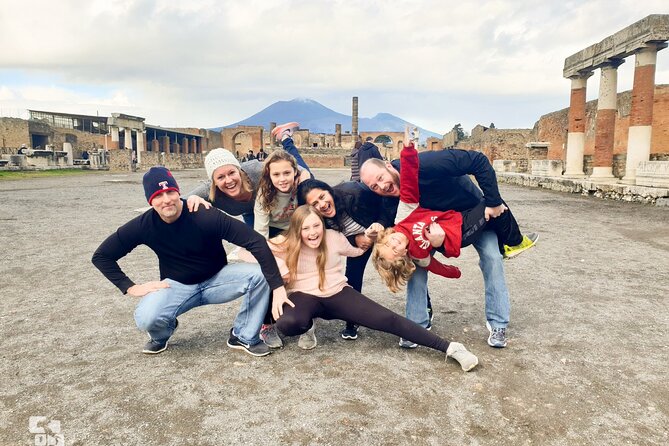
Mount Vesuvius forms the northern backdrop, a reminder of the event that ended the city’s Roman life in AD 79. Around the plaza were buildings for law, worship, government, trade, and public ceremony.
At the southwest corner, the Basilica served as Pompeii’s main courthouse and business center. It was not a church. Its large three-aisled interior once held 28 brick columns, and the raised tribunal at the far end marks where magistrates handled legal matters.
I find this stop useful because it corrects a common misunderstanding. Roman public life was not separated into neat modern categories. Commerce, law, politics, religion, and social status all met around the Forum.
More ways up Mount Vesuvius:
- Priority Access Pompeii & Mt. Vesuvius Full day from Sorrento
★ 4.5 · 1,376 reviews - From Sorrento: Pompeii and Vesuvius Guided Tour with Lunch
★ 4.8 · 683 reviews - From Sorrento: Day Tour to Pompeii Ruins and Mount Vesuvius
★ 4.3 · 489 reviews - From Sorrento: Pompeii and Vesuvius Tour
★ 4.5 · 201 reviews
Temples, markets, and ancient shopping
The Temple of Apollo is one of Pompeii’s oldest sacred places, with origins reaching back to the sixth century BC. Its design combines Greek and Italic elements, and the surrounding portico once held 48 columns.
You can see a white marble altar and an Ionic column topped by an ancient sundial. Bronze statues of Apollo and Diana now represent the originals, which are held in Naples. The setting also provides one of the classic Pompeii views toward Vesuvius.
Nearby, the Macellum shows the practical side of ancient life. This was the city’s main food market, with shops around a central courtyard. A circular pavilion occupied the middle, and evidence from the drainage system points to fish being cleaned and sold there.
The market also included a stone table for checking official weights and measures. That small feature says a great deal about Roman commerce. The city had systems for regulating trade, not just stalls and shouting vendors.
The Forum Baths and Roman comfort
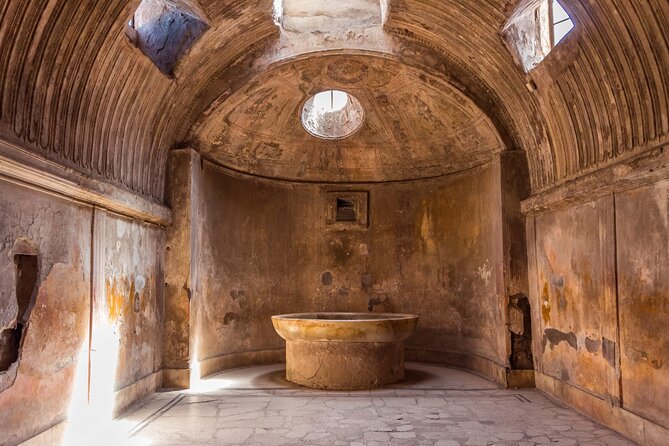
The Forum Baths offer one of the clearest looks at everyday Roman routine. These baths were still operating when Vesuvius erupted, and the sequence of rooms remains easy to understand.
You move through the changing room, cold room, warm room, and hot room. The building’s heating system used hollow walls and floors to move hot air, an impressive piece of engineering for the period.
Look for the stucco decoration on the ceilings and the original bronze brazier. The women’s section has also reopened, with painted decoration that helps show how the bathing system served different parts of the population.
The baths were not simply places to wash. They were social spaces for conversation, exercise, and relaxation. Fabrizio’s explanations are especially useful here because the rooms can otherwise look like a series of empty chambers.
Pompeii’s grand private houses
The House of the Faun occupies an entire city block and gives you a sense of elite wealth. Its two atriums and two garden courtyards show how much space a powerful household could control inside a dense Roman city.
The house is named after the bronze Dancing Faun once displayed in its entrance courtyard. The original statue, like the famous Alexander Mosaic depicting the Battle of Issus, is now in the Naples Archaeological Museum. Replicas remain at the site.
Even without the original art, the building itself is worth seeing. Its size, garden design, flooring, and painted decoration make the social gap between rich homeowners and ordinary residents clear.
The House of the Vettii offers a different story. Its owners were two brothers who had risen from slavery to become wealthy merchants. The home’s Fourth Style wall paintings are its main attraction, including the Room of the Cupids and mythological scenes in the dining rooms.
A peristyle garden sits at the center, replanted according to ancient patterns. The entrance painting of Priapus represents prosperity, while the house as a whole shows how recently successful families used decoration to announce their status.
These homes are why a private guide earns his keep. Without explanation, you see rooms. With context, you begin to understand social ambition, household structure, wealth, and the way Roman owners displayed success.
The Chaste Lovers and Pompeii still in progress
The Insula dei Casti Amanti, or Block of the Chaste Lovers, offers a look at archaeology as ongoing work rather than finished history. The block includes houses, a bakery, and the House of the Painters at Work.
A raised walkway lets you see the excavation area from above. The route gives you a broad view of the buildings while keeping visitors separate from the work below. It is also part of the Pompeii for All barrier-free route.
This stop is especially interesting if you want to see how archaeologists study a site today. Pompeii is not simply an old place waiting for tourists. New discoveries, conservation work, and interpretation continue.
Access and open areas can change at archaeological sites, so your exact route may vary. That is another reason the private format helps. Fabrizio can adjust the plan if a particular house or passage is unavailable.
Theater life at Teatro Grande
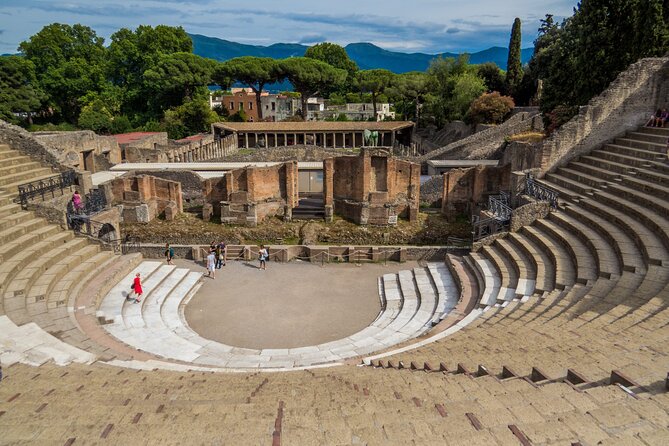
The Large Theatre could seat about 5,000 people in its horseshoe-shaped bowl. It was built into a natural slope, which helped create the shape and offered good sightlines.
The seating also reflects Roman social order. Higher-status spectators occupied the lower sections, while the general population sat farther up. You can still see the divisions in the surviving tiers.
The theater’s acoustics remain impressive. Speaking from the orchestra can show how sound carried across the space. The setting also gives you another view toward Vesuvius.
Theater remains part of Pompeii’s modern cultural life, with events such as the Pompeii Theatrum Mundi summer season. If your visit coincides with a performance or special event, access and timing may differ, so ask about the day’s schedule.
The Antiquarium and the human side of Pompeii
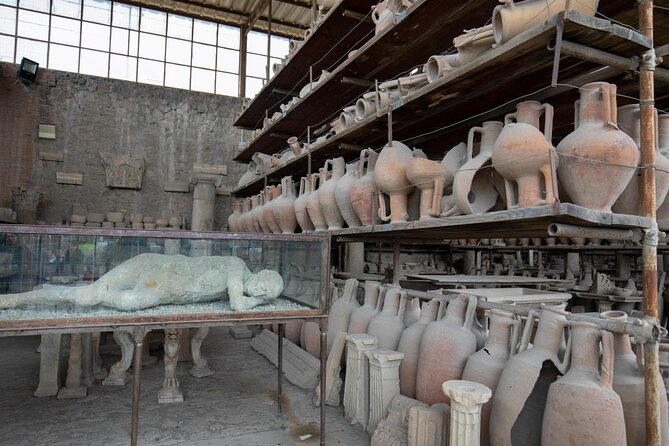
The Antiquarium near Porta Marina is a useful place to see objects that cannot remain outdoors. The museum traces Pompeii from its earlier Samnite roots through Roman rule and the eruption.
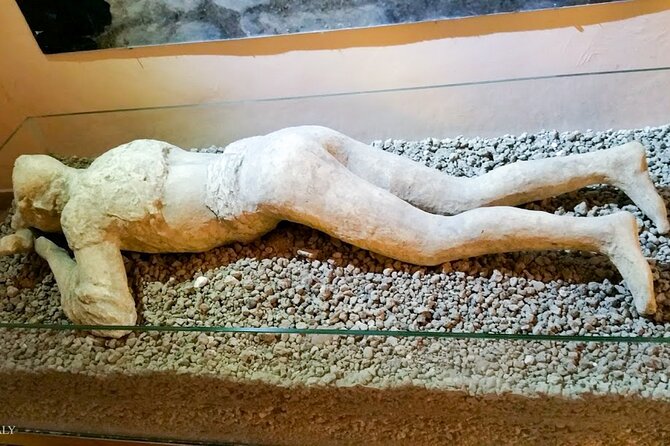
Highlights include the Moregine silver treasure, a collection of amulets sometimes called the sorcerer’s hoard, and frescoes from the House of the Golden Bracelet. The plaster casts are the most moving display, including the Dog of Pompeii and casts of people caught in the eruption.
I recommend treating this stop as more than a museum add-on. The ruins show streets and buildings. The Antiquarium supplies possessions, decoration, and human remains. Together, they make the city easier to understand as a lived community.
Depending on the day’s route and your interests, Fabrizio may use the museum as an introduction or as a final reflection after the outdoor walk.
Lunch and five wines at Cantina del Vesuvio
After Pompeii, the drive to Cantina del Vesuvio takes about 10 to 15 minutes. The winery is in Mount Vesuvius National Park, but the tour does not climb to the crater.
The winery visit begins with a guided 15-minute walk through the vineyards. You learn about the local grapes and Lacryma Christi wines while looking across the Bay of Naples and toward the volcano.
The meal is served with five wines. The sample menu begins with ricotta, bruschetta topped with cherry tomatoes, provolone, salami, and capocollo. The main course is spaghetti with Vesuvius cherry tomatoes, followed by pastiera, a Neapolitan cake made with ricotta and wheat.
The meal is simple, local, and well matched to the setting. This is not a formal wine seminar. It is a relaxed food-and-wine stop where you can sit down after several hours on ancient paving.
Vegetarian and gluten-free choices are available. The winery can also arrange shipment of wine and olive oil if you find something worth bringing home.
The supplied details give two prices for the tasting: €50 for the classic option and €60 for the superior option, while another description lists €55 and €65. Because of that difference, confirm the current price with Fabrizio before departure. Payment is made at the winery by card or cash.
Is the $434.46 price fair?
At $434.46 per person, this is not a budget Pompeii visit. The price makes more sense for a small private group that values door-to-door transport, a professional guide, and a customized route.
Included are Pompeii Express skip-the-line admission, private transport in an air-conditioned Mercedes minivan, the private walking tour, and the winery reservation. The lunch and wine tasting are extra, adding €50 or €60 per person according to the stated options.
For one person or a couple, the cost is substantial. For a family or group splitting the vehicle and guide expense, the convenience becomes easier to justify. You are paying for time saved, a private schedule, and interpretation that a self-guided visit does not provide.
I would not choose this tour if your main goal is the cheapest possible Pompeii entry. I would consider it good value if you are staying in Sorrento or Naples, want a private day, and prefer to finish with a proper meal rather than arranging transport and lunch yourself.
Practical details before you book
Pickup and drop-off are available, but you must provide your meeting location and phone number. The experience is offered in English, and only your group participates.
Plan on moderate physical fitness. Pompeii is large, and even a focused route involves walking across ancient streets and open areas. Children must be accompanied by an adult, and service animals are allowed.
Free cancellation is available up to 24 hours before the start time. Changes or cancellations inside that window are not accepted for a refund.
The activity is often reserved well ahead, with average bookings made about 112 days in advance. If you have a fixed date during a busy Sorrento stay, planning early is sensible.
Who should book this Pompeii day?
I would choose this for a first visit to Pompeii, especially if you want the major sights without trying to cover every corner. It also suits families, older adults who need a slower pace, and anyone who prefers a guide who can adjust the route.
History fans will appreciate the archaeologist’s background. People who are less interested in ancient history may still enjoy the day because the focus includes food, homes, theaters, baths, and ordinary routines.
You should think twice if you want to climb Mount Vesuvius. This tour visits a winery on the volcano, but it does not reach the crater. You should also check the final lunch price if keeping to a strict budget.
The tour has a 5 out of 5 rating from 57 ratings, with 100 percent recommendation shown in the supplied information. The strongest pattern is clear: Fabrizio’s preparation, humor, patience, and ability to adapt the walk are central to the experience. His contact before the tour also helps groups plan their arrival and interests.
Should you book it?
Book this tour if you want Pompeii explained by an archaeologist, private transport from Sorrento or Naples, and a comfortable food-and-wine finish at Mount Vesuvius. The combination is especially useful when your time is limited or your group does not want to manage trains, tickets, and a winery reservation.
Skip it if you want a low-cost independent visit, a full climb of Vesuvius, or a long technical wine course. For everyone else, the strongest reason to book is the balance: serious archaeology first, then a generous Neapolitan lunch at a family winery.
FAQ
Is hotel pickup included?
Private pickup and drop-off are included, with arrangements made using your meeting location and phone number. Pickup is offered from Sorrento and Naples.
How long does the experience last?
The tour lasts approximately four to seven hours. The timing depends on the Pompeii route, your walking pace, and the time spent at the winery.
Is Pompeii admission included?
Pompeii Express skip-the-line admission is included when the admission option is selected as part of the tour.
Is lunch included in the listed price?
No. The winery visit and reservation are included, but lunch and wine tasting are paid at the winery. The stated options are €50 for the classic tasting or €60 for the superior experience, though another supplied price lists €55 and €65, so confirm the current amount.
Does the tour climb to the top of Mount Vesuvius?
No. The tour visits Cantina del Vesuvio in Mount Vesuvius National Park but does not reach the volcano’s summit or crater.
Can the Pompeii route be adjusted?
Yes. Fabrizio can plan the walking route around your interests and physical pace. You can send special requests ahead of time.
More Pompeii tours from Sorrento
- Sorrento: Skip-the-Line Pompeii Express Tour by Train
★ 4.8 · 2,038 reviews - Pompeii Express Guided Tour by Train from Sorrento
★ 4.5 · 770 reviews - Skip-the-Line Pompeii Guided Tour from Sorrento
★ 4.5 · 722 reviews - Pompeii Ruins Half-Day Tour from Sorrento with Guide
★ 4.0 · 714 reviews
New on the Sorrento list
- Vico Equense: Authentic Cooking Class at a Local’s Home★ 5.0 · 4 reviews
- Vico Equense: Dining Experience at a Local’s Home★ 5.0 · 4 reviews
- Vico Equense: Tour in the dairy “Mozzarella Experience”★ 5.0 · 19 reviews
- Private tour of Amalfi Coast★ 5.0 · 71 reviews
- Private Virtual Cooking Class from Sorrento★ 5.0 · 25 reviews
- Sorrentomaxiboat tours to Capri★ 5.0 · 63 reviews
- Private transfer from Salerno to the Amalfi Coast, or vice versa★ 5.0 · 30 reviews
- Yoga Experience – Sorrento★ 5.0 · 29 reviews
Wine Tours in Sorrento, compared.
Sorrento Farm and Food Experience including Olive Oil, Limoncello, Wine tasting
Read our review →
Pizza Lesson, Wine, and Limoncello at a Local Farm
Read our review →
Amalfi Coast Day Tour from Sorrento with Light Lunch and Wine
Read our review →
Pizza School with Wine and Limoncello Tasting in a Local Farm
Read our review →
Authentic Farm Tour with Pizza, Cheese, Wine & Limoncello Tasting
Read our review →

Toss, Bake, Cheers! – Sorrento Pizza Making Class with Wine
Read our review →
E-Bike Food and Wine Tour in the Sorrento Peninsula
Read our review →Browse the lists this tour appears in